
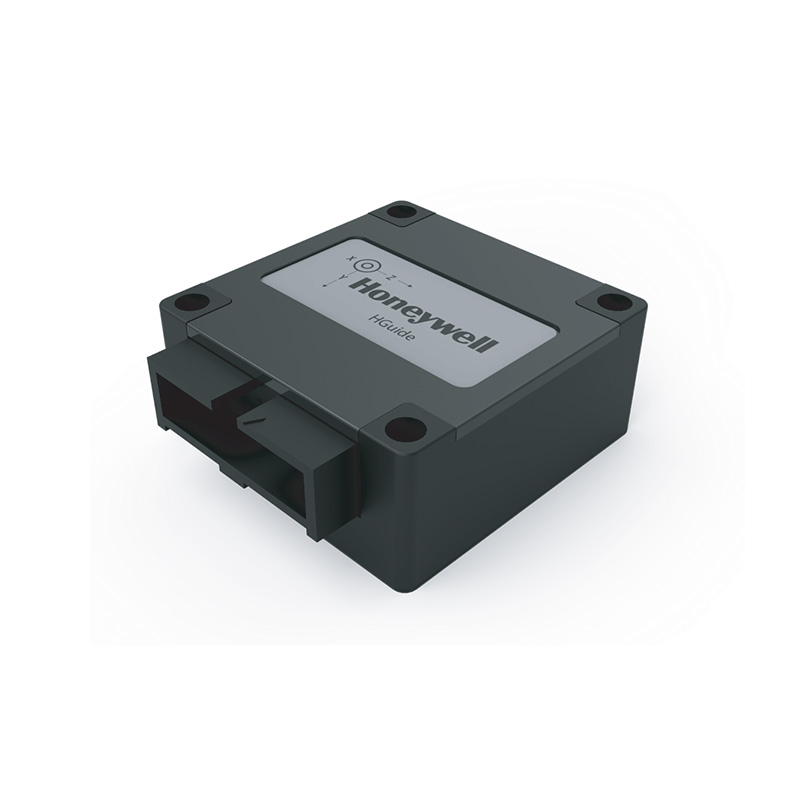
HGUIDE i400 MEMS Inertial Measurement Unit
The HGuide i400 is an advanced microelectromechanical systems (MEMS)-based inertial measurement unit (IMU)
designed for applications that require high performance, compactness, lightweight, and rugged form factor. With industry-standard communication interfaces and a wide input voltage range, it can be seamlessly integrated into a variety of architectures. The HGuide i400 is small, lightweight, and power-consuming, making it suitable for applications ranging from 3D mapping to autonomous driving and autonomous underwater vehicles (AUVs).
Accurate inertial measurement is essential in applications that require reliable motion data, responsive control, and stable operation under changing environmental conditions. From industrial navigation and robotics to stabilization systems and other embedded platforms, engineers need inertial measurement units (IMUs) that combine compact dimensions with dependable sensor performance.
The Honeywell HGuide i400 MEMS Inertial Measurement Unit is designed for applications where size, weight, power consumption, and measurement capability must be carefully balanced. Integrating MEMS gyroscopes and accelerometers in a compact package, the i400 provides inertial data and roll-and-pitch outputs for integration into suitable control and navigation systems.
This article explores the key features of the HGuide i400, its technical specifications, and the engineering considerations involved in selecting an IMU for demanding applications.
What Is the Honeywell HGuide i400 IMU?
The Honeywell HGuide i400 is a compact inertial measurement unit that combines gyroscope and accelerometer sensing in a small mechanical assembly. Its design aims to reduce the effects of mechanical interference inputs that can affect measurement performance in real-world operating environments.
The unit measures approximately 28 × 25 × 13 mm, occupies less than 8 cubic centimeters, and weighs approximately 18 grams. With power consumption specified at less than 0.5 watts, it can be considered for embedded systems where installation space and available power are limited.
The i400 provides standard inertial sensor data and roll-and-pitch information, allowing system designers to integrate its outputs into applications that require motion measurement or attitude-related data.
Its suitability for a particular system depends on sensor performance requirements, mounting conditions, interface compatibility, software integration, and the intended operating environment.
Key Technical Specifications of the HGuide i400
The HGuide i400 offers a combination of compact packaging, configurable data output, and multiple communication options.
| Parameter | Specification |
|---|---|
| Dimensions | 28 × 25 × 13 mm |
| Volume | Less than 8 cm³ |
| Weight | 18 g |
| Power consumption | Less than 0.5 W |
| Operating temperature | -40°C to +85°C |
| Gyroscope operating range | ±490°/s on all axes |
| Accelerometer operating range | ±16 g on all axes |
| Inertial data rate | Up to 600 Hz |
| Control data rate | Up to 1,800 Hz |
| Default roll-and-pitch output | 100 Hz |
| Supply voltage | +4.5 to +15 VDC |
| Bandwidth | 200 Hz at -3 dB, depending on output frequency |
| Communication interfaces | RS-422 differential and 3.3 V TTL UART |
| Default asynchronous baud rate | 1 Mbps |
| Discrete signal | Data-ready output |
| Shock specification | 40 g, 11 ms, per stated MIL-STD-810G specification |
| Vibration specification | Random vibration, 20–2,000 Hz, 2.2 g RMS, per stated MIL-STD-810G specification |
These specifications provide a starting point for evaluating the sensor. Before system integration, engineers should confirm the applicable datasheet revision, output configuration, environmental test conditions, and interface requirements.
1. Compact Design for Space-Constrained Systems
Size and weight can significantly affect the design of embedded equipment, particularly when an IMU must fit inside a compact enclosure or be installed close to a system's measurement reference point.
The HGuide i400's 18-gram weight and small footprint offer flexibility for applications where conventional, larger inertial sensors may be difficult to accommodate.
Potential integration scenarios include compact robotics, stabilization equipment, embedded motion-control platforms, and selected navigation systems. The final application should be assessed according to the required accuracy, dynamic range, vibration environment, and system-level performance criteria.
For designers working with strict dimensional limits, the mechanical drawing and mounting requirements should be reviewed early in the development process.
2. MEMS Gyroscopes and Accelerometers for Motion Measurement
An IMU uses gyroscopes to measure angular velocity and accelerometers to measure specific force along multiple axes. These measurements provide essential inputs for systems that estimate movement, monitor orientation, or support control functions.
The HGuide i400 integrates MEMS gyroscope and accelerometer sensors, with a listed gyroscope operating range of ±490 degrees per second and an accelerometer range of ±16 g on all axes.
Its compact mechanical design is intended to reduce interference inputs encountered in practical applications. Nevertheless, the performance of an installed IMU depends on more than its sensor specifications. Mechanical mounting, vibration transmission, thermal conditions, electrical noise, and system calibration can all influence the quality of the measurements.
Engineers should therefore evaluate the i400 under representative operating conditions rather than relying solely on nominal sensor ranges.
3. Temperature Compensation and Environmental Robustness
Equipment used in industrial and outdoor environments may experience substantial temperature changes, mechanical shock, and continuous vibration. These conditions can influence sensor bias, scale factor, and measurement stability.
The HGuide i400 is specified for an operating temperature range of -40°C to +85°C. Honeywell's stated capabilities include calibration and compensation across the operating temperature range, supporting applications that require operation under varying thermal conditions.
The supplied specifications also list shock and random-vibration test conditions based on MIL-STD-810G. These characteristics may be relevant when evaluating the sensor for mechanically demanding installations.
However, component-level environmental specifications do not automatically establish the environmental performance of the complete product. Mounting hardware, enclosure design, cabling, and the surrounding system must also be considered during qualification.
4. Configurable Data Rates and Communication Interfaces
Communication compatibility is a critical part of IMU selection. The sensor must provide data at the rates required by the host controller while supporting a suitable electrical interface and data-processing architecture.
The HGuide i400 supports inertial data rates of up to 600 Hz and control data rates of up to 1,800 Hz. Its default roll-and-pitch output rate is listed as 100 Hz, while configuration options allow data rates and baud rates to be selected according to system requirements.
The available communication interfaces include RS-422 differential communication and 3.3 V TTL UART. These options provide flexibility for different embedded hardware designs, subject to the host system's electrical and protocol requirements.
The unit also provides a data-ready output, which can help a host controller coordinate data acquisition. During integration, developers should verify message timing, interface wiring, baud-rate settings, and data synchronization requirements.
5. Software and Development Support
An IMU's practical value depends partly on how easily engineers can access, interpret, and integrate its data.
The HGuide i400 uses Honeywell's proprietary binary data format, identified in the supplied documentation as HGN[1]SI. Honeywell provides development resources that include a ROS driver, software development kit (SDK), and HGuide Data Reader software.
These resources can support evaluation, data inspection, and software integration workflows. Before development begins, engineers should check software versions, operating-system compatibility, supported interfaces, and the availability of the relevant documentation.
For projects that rely on ROS or custom embedded software, early interface testing can help identify integration issues before the complete system reaches its validation stage.
6. Potential Applications of the HGuide i400
The combination of compact size, low power consumption, configurable output rates, and environmental specifications makes the HGuide i400 a candidate for a range of embedded motion-sensing applications.
Potential areas of evaluation include:
-
Robotics and automation: Providing inertial measurements for motion monitoring and selected control functions.
-
Stabilization systems: Supplying angular-rate and attitude-related data to compatible stabilization architectures.
-
Industrial navigation: Supporting inertial sensing within a larger navigation system.
-
Embedded motion-control equipment: Integrating inertial measurements into systems with strict size and power constraints.
-
Engineering research and development: Supporting sensor evaluation, algorithm development, and prototype testing.
These are potential application areas rather than guarantees of suitability. Actual performance depends on the required accuracy, drift characteristics, vibration conditions, update rate, and system-level design.
How to Evaluate an IMU Before Integration
When comparing compact IMUs, engineers should assess the complete set of requirements rather than selecting a sensor based on size or output rate alone.
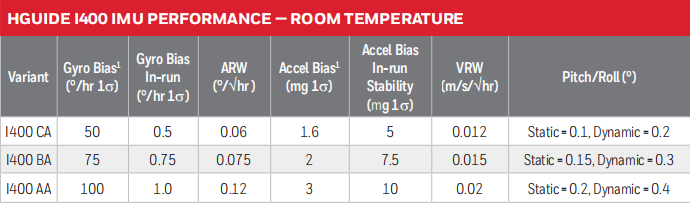
First, verify gyroscope bias stability, noise characteristics, accelerometer performance, and any required attitude-estimation specifications. A stated gyroscope performance figure of less than 1°/h should be interpreted according to the manufacturer's defined test conditions and performance metric.
Second, confirm the required data rate, communication protocol, supply voltage, and software support. Third, evaluate temperature, vibration, shock, and mounting requirements against the actual application environment.
Finally, review calibration requirements, system integration effort, product documentation, and lifecycle support. These steps help determine whether the sensor is appropriate for the intended application and reduce uncertainty during development.
Conclusion
The Honeywell HGuide i400 MEMS IMU combines a compact mechanical design, low power consumption, configurable data output, and multiple communication interfaces. Its gyroscope and accelerometer measurements, roll-and-pitch output, and supporting software tools make it worth evaluating for embedded systems that require compact inertial sensing.
For engineers and system integrators, the most important step is to match the sensor's verified performance and interface capabilities with the requirements of the complete system. Reviewing the official datasheet, testing the unit under representative conditions, and confirming software compatibility can help establish whether the HGuide i400 is the right choice for a particular project.
For technical specifications, integration documentation, and product availability, consult Honeywell's official documentation or an authorized supply channel.
Related products
-
 Contact Us
Sintered Ferrite Magnet is the 3rd generation of peranent magnet developped in 1980.
-
 Contact Us
The HGuide o360 is a single-card INS/GNSS, all attitude Inertial/GNSS Navigator designed for any platform where high performance navigation data is required in an ultra-low SWAP package.
-
 Contact Us
The HG4930 is a high-performance microelectromechanical systems (MEMS) inertial measurement unit (IMU) designed to meet the needs of a wide range of market applications in agriculture, AUV, industrial equipment, robotics, survey/mapping, stabilization platforms, transportation, unmanned aerial vehicles (UAVs), and unmanned ground vehicles (UGVs).
-
 Contact Us
PRODUCT DESCRIPTION Name PET Chair Mat on Carpet Material PET sheets Shapes Rectangle, Square, Circle or Custom Shapes MMT 75*124cm, 90*120cm or Custom MMT Thickness 2.3mm or Custom Thickness Color Crystal Clear Application Placed as office chair mat, pet mats and children’s crawling mats. It can also be placed on the top of the carpets …
-
 Contact Us
Consumer Electronics PCBAs are circuit board assemblies designed for a wide range of everyday electronic devices, offering compact design, reliable performance, and cost-effective manufacturing.
Reviews
There are no reviews yet.