

C21000 to C28000 Brass Supplier: Industrial Grade Selection
C21000 to C28000 Brass Supplier: Industrial Grade Selection
C21000 to C28000 Brass for Industrial Buyers: Grades, Temper, and Verification
For industrial procurement teams sourcing brass in the C21000 to C28000 span, the practical questions are consistent: which composition actually matches the application, what temper will hold up in service, and how does the material get verified before it enters production. Jiangsu Xinxiangsheng Special Steel Co., Ltd. supplies copper and copper alloy products across the ASTM C-series and equivalent GB designations, and the following review consolidates the technical detail buyers need when comparing a specification against a quotation.
What the C21000–C28000 Range Represents
Copper materials are categorized by composition into two main groups: pure copper and copper alloys. Common alloys include brass (copper-zinc), bronze (copper-tin, copper-aluminum), and cupronickel (copper-nickel). The identification key is straightforward: grade prefixes T, TU, and TP denote pure copper, while H denotes brass, and the C-series indicates ASTM grades — "grades starting with C1 are typically pure copper, while those starting with C2 are typically brass."
Within that C2 brass family, documented reference points include C26000, C27000, and C28000, with copper contents of approximately 68.5–71.5%, 64–67%, and 59–62% respectively, roughly corresponding to H70, H66, and H60. Because composition ranges are reference values, the supplier notes that "the grade standards shall prevail" — a point worth confirming on any inquiry.
Matching Composition to Application
Brass composition determines strength, machinability, appearance, and formability, and Jiangsu Xinxiangsheng’s grade coverage maps directly onto those trade-offs:
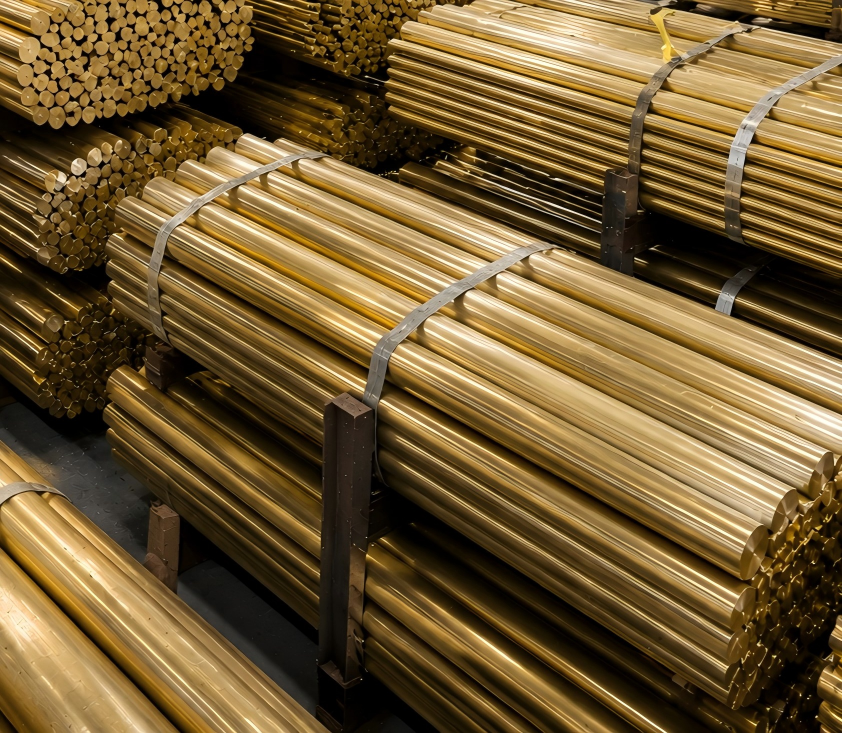
- H59 (57–60% Cu) — the lowest copper content in the brass line, positioned toward hardness and economy.
- H62 (60.5–63.5% Cu) — a widely used general-purpose brass for hardware, valves, profiles, and deep-drawn parts.
- H65 (63–66% Cu) and H68 (67–70% Cu) — higher copper content, used in tubing and forming-intensive work.
- H80 (79–81% Cu) — the highest copper content in the brass range, with the remainder zinc, suited to decorative craft items and profiles.
Across these grades, brass is characterized by high strength, good machinability, and a golden-yellow appearance, and is applied to tubing, hardware, valves, lighting fixtures, and connectors. Where a buyer’s C21000 to C28000 target sits outside the grades explicitly tabulated, the equivalent GB designation and copper range should be fixed in writing against the governing standard before the order is released.
Specification Discipline: The Four Elements
Jiangsu Xinxiangsheng Special Steel Co., Ltd. advises that a quote request specify the four key elements: "Grade + Temper + Cross-section + Standard." For conductive busbar applications, the recommendation is pure copper busbar material such as TMY/T2 or C11000, with attention to electrical conductivity — typically ≥ 46 m/(Ω·mm²) at 75°C — and straightness. The same discipline applies to brass: temper and cross-section are not interchangeable variables.
Temper Designations and Heat Treatment
Temper governs ductility, strength, and grain structure, and it is established through annealing, since cold working causes work hardening that necessitates alternating annealing steps.
- M (Soft Temper) — fully annealed, high ductility and low strength; suitable for bending, flaring, and deep drawing. Designations include T2M and H62M.
- M2 (Light Soft) — lightly soft-annealed, sitting between soft and half-hard, commonly used under GB/T 1527.
- Y2 (Half-Hard) — half-hardened by cold working, balancing strength and ductility with good structural support; designations include T2Y2 and H62Y2.
- Y (Hard Temper) — hardened by cold working, high strength and rigidity but poor formability; designations include T2Y and H62Y.
- O60 (Air Conditioning Tube) — a soft-annealed temper recognized in air conditioning and refrigeration work, for example TP2 O60.
Annealing parameters directly determine whether the delivered material ends up soft, half-hard, or hard, and the resulting grain size.
Process Chain Behind Every Consignment
Production begins with copper cathode (electrolytic copper) at ≥99.95% copper content, with qualified scrap permitted as a blend and batching performed according to grade specifications. The main chain runs through smelting and casting, hot working, cold working, heat treatment, and inspection and packaging. Hot working — hot rolling at approximately 800–950°C — breaks down as-cast dendrites, eliminates porosity, and refines grains. Cold working controls dimensional accuracy through cold rolling, floating-mandrel or coil drawing, and wire drawing.
For copper busbars, the typical route is: Copper Cathode → Melting → Upward Casting (Rod) → Extrusion → Drawing → Cutting to Length → Inspection → Warehousing. Key control points include straightness (e.g., ≤ 0.5 mm/m), electrical conductivity, edge chamfering, and dimensional tolerances. For copper tubes, control concentrates on wall thickness uniformity, inner surface cleanliness, and grain size in the annealed state, with air-conditioning tubes additionally requiring eddy current testing and hydrogen embrittlement testing. Copper plates and strips are governed by thickness tolerance, flatness, absence of surface scratches or indentations, and stamping formability; copper wire by wire diameter tolerance, electrical conductivity, wire breakage rate, and flexibility; and copper braided wire / flexible connectors by braid density, contact resistance, and terminal security.
Documentation and Quality Verification
Inspection covers chemical composition, mechanical properties, electrical conductivity, flaw detection, dimensions, and surface quality, with moisture-proof packaging and mandatory standard-compliant sampling and retention of test reports prior to shipment. Jiangsu Xinxiangsheng Special Steel Co., Ltd. provides material and quality certificates covering chemical composition, mechanical properties, and electrical conductivity, and can issue third-party or commercial inspection reports upon request — the practical route for buyers running their own incoming quality testing. Sample evaluation and report review should be scheduled against the same standard referenced in the purchase specification.
Frequently Raised Points
Buyers crossing from Chinese National Standards to ASTM designations should note that "alloys with the same composition often correspond to both GB and ASTM designations" — for example, TP2 ≈ C12200 and T2 ≈ C11000. Pricing follows a floating model of "LME/SHFE Copper Price + Processing Fee," so the pricing cycle and the price-fixing method are worth clarifying at inquiry stage.
For an industrial brass program spanning C21000 to C28000, the reliable path is a fully specified four-element request, a temper matched to forming and service conditions, and documented verification against the governing standard.
Related products
-
 Contact Us
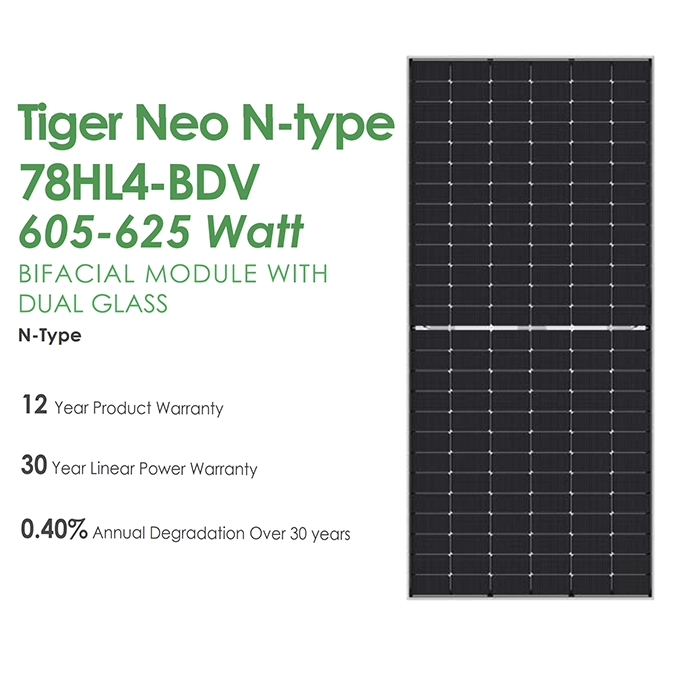
Model NO:78HL4-BDV 605-625 Watt
Cell Type: N-type Mono-crystalline
Weight:34.6 kg
Transport Package:Wooden Pallet and Carton Packing
Specification:2465*1134*30mm
Trademark:Jinko solar
Origin:China -
 Contact Us
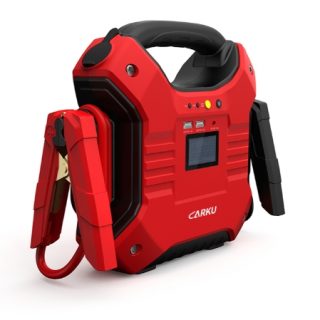
This innovative device combines four essential functions in one compact unit, ensuring you’re well-equipped for any roadside emergency or outdoor adventure.
-
-
 Contact Us
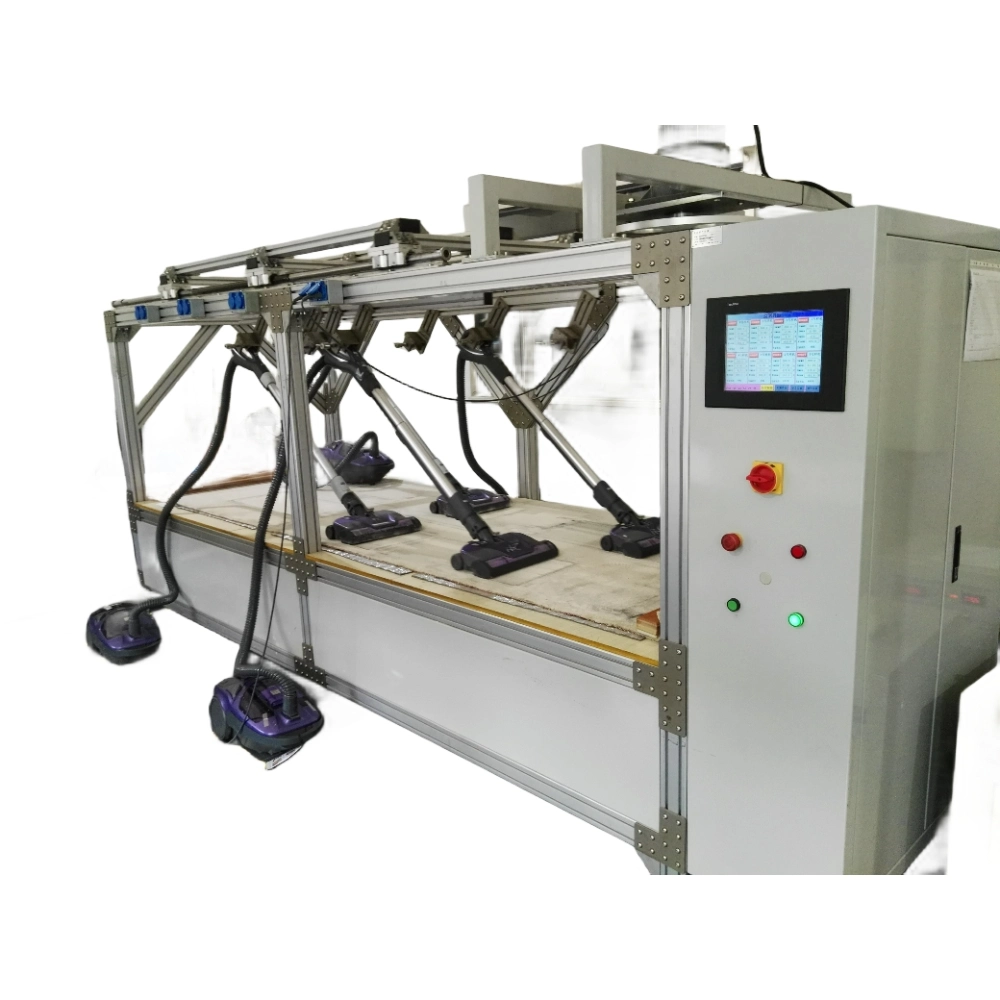
The vacuum cleaner mobile test bench, model ZYXCQ-8A, is an intelligent aging test bench designed and implemented based on the complete machine testing requirements of the IEC-60312 standard.
-
 Contact Us
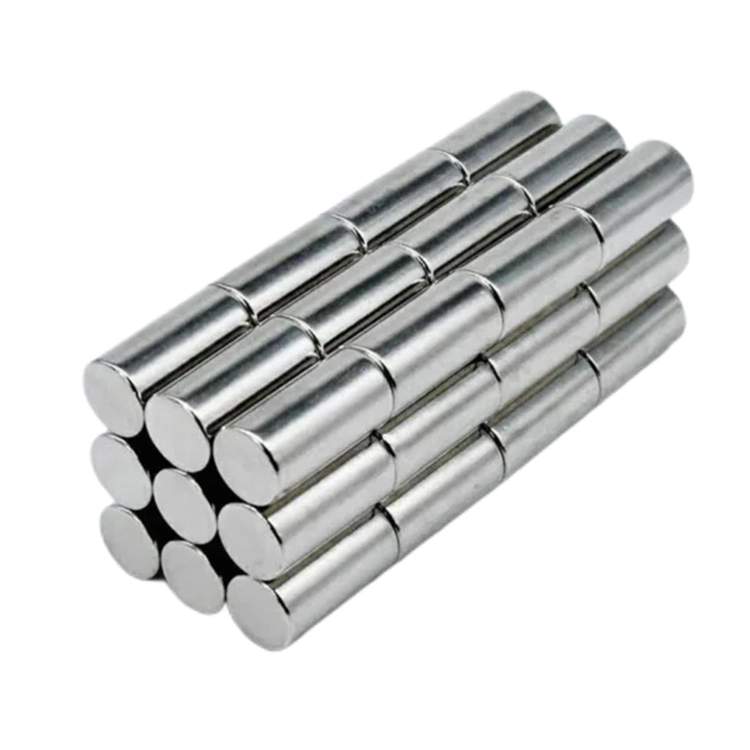
1.Cylindrical magnet
2.Size:customized
3.Grade:selectable
4.Cladding:ZN/NI/NICUNI/Black epoxy
Reviews
There are no reviews yet.