

Granite Saw Blade Service Life: What Determines Durability?
Granite Saw Blade Service Life: What Determines Durability?
Granite fabricators, quarry operators, and stone-processing factories around the world consistently face one recurring question: how long will a diamond saw blade actually last before performance drops or the segment fails? The answer depends on a combination of segment formula, blade construction, machine conditions, and cutting parameters — and this is precisely where XRT Diamond Tools, operating under the full corporate name Quanzhou Xinruite (XRT) Diamond Tools Co., Ltd., has built its technical reputation since 2001.
Understanding What Drives Granite Saw Blade Service Life
Service life for a granite saw blade is rarely determined by a single factor. According to the technical framework used by XRT Diamond Tools, the key variables influencing durability include stone hardness and abrasiveness, machine type, blade diameter, spindle speed, feed speed, and cutting depth. Granite, being a hard natural stone, places significant stress on diamond segments, which can lead to common pain points such as insufficient cutting sharpness, short or inconsistent segment lifespan, segment cracking or premature wear, and excessive cutting resistance or heat generation.
These issues are rarely solved by a single universal blade design. Instead, XRT Diamond Tools emphasizes that diamond bond formulas and blade configurations must be adjusted according to the specific stone type and machine conditions rather than relying on one formula for all applications.
XRT Diamond Tools’ Approach to Formula Development and Durability
At the core of XRT’s technical capability is its diamond bond formula development process. Formulas are adjusted based on stone hardness and abrasiveness, machine type, blade diameter, cutting speed, cutting depth, required sharpness, and expected tool lifespan. This approach allows the company to balance two factors that are often in tension: sharpness and service life. A blade that cuts aggressively but wears out quickly is not necessarily the most cost-effective solution, nor is an overly hard formula that cuts slowly but lasts longer. XRT’s customization philosophy targets the specific balance each customer’s granite application requires.
Manufacturing and quality control play a direct role in supporting consistent service life. XRT applies specialized production processes and inspection procedures to control dimensional accuracy, segment consistency, bonding quality, and overall cutting performance, helping reduce batch-to-batch variation that can otherwise shorten blade lifespan unpredictably.
Technical Specifications Supporting Longer Service Life
Granite saw blades from XRT are available across a wide diameter range — from 180mm to 3500mm — covering applications from handheld angle grinders to large block-cutting machines. Supporting specifications include standard arbor/bore sizes of 22.23mm, 25.4mm, 50mm, and 60mm (with custom sizes available on request), and segment heights of 10mm, 12mm, 15mm, and 20mm. Segment types include U-gullet, keyhole gullet, short R-splitting, and multi-blade profile designs, each suited to different machine compatibility requirements such as bridge saws, multi-blade machines, single block cutters, and manual angle grinders.
For smaller-scale and onsite granite work, the 180mm diamond saw blade illustrates how specification choices directly affect service life. This blade is designed for handheld angle grinders and small fabrication equipment, with bore sizes of 22.23mm/25.4mm and segment heights of 10mm/12mm, available in continuous rim, segmented, or turbo configurations, and in silent or non-silent cores. Its compact design is intended to reduce core deflection under high hand-held cutting pressure and rapid segment wear on small machines, two common causes of shortened service life in onsite granite trimming and edge work.
Real-World Performance: Customer Cases
North Korea Granite Fabrication Case
A stone-processing company requiring granite diamond saw blades needed multiple blade diameters with stable cutting performance, good sharpness, and specifications suited to existing machinery. XRT supplied application-specific granite saw blades with blade diameter, arbor size, segment specification, and cutting performance selected according to the customer’s requirements. The technical focus centered on cutting efficiency, blade stability, edge quality, and service life, with further optimization available based on ongoing customer cutting feedback.
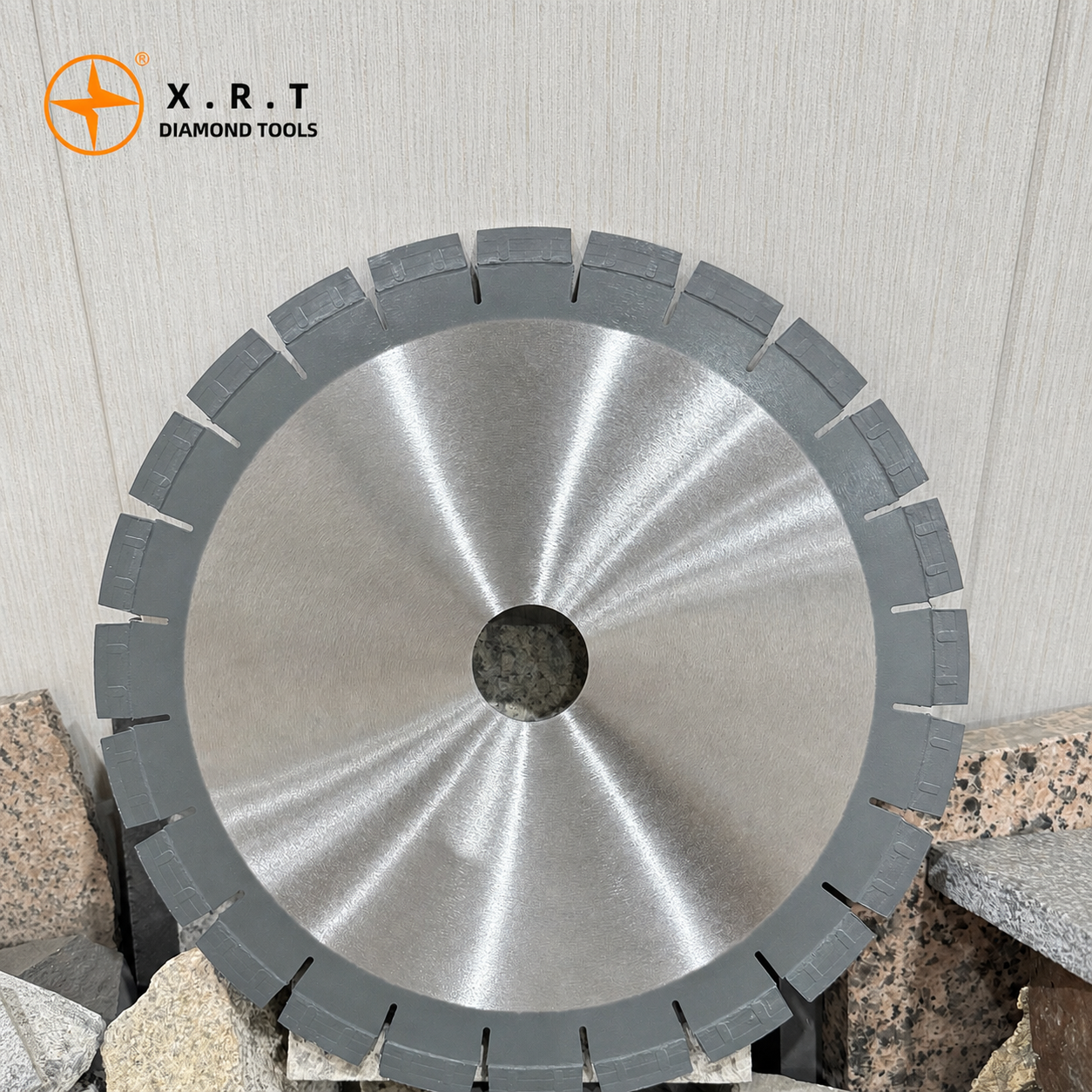
While several of XRT’s documented field cases involve segments for andesite and gabbro rather than granite specifically, they reflect the same underlying formula-adjustment methodology applied to granite applications — matching bond hardness and segment structure to stone abrasiveness and machine conditions to extend usable blade life without sacrificing cutting sharpness.
Balancing Cost Per Cut and Tool Lifespan
Service life cannot be evaluated in isolation from pricing and overall processing economics. XRT’s pricing approach is based on product specifications, diamond segment formula, raw material requirements, order quantity, customization level, and delivery terms, with competitive factory-direct pricing available for both regular-volume and bulk orders. Importantly, the company states that its value focus is on helping customers reduce overall cost per cut rather than competing solely on the lowest unit price — meaning a slightly higher-cost blade that delivers longer service life and more stable cutting may ultimately lower total processing expense.
Service and Technical Support for Sustained Performance
Because granite cutting conditions vary by machine, stone source, and operating practice, XRT supports ongoing technical adjustment rather than a one-time product sale. The company provides product selection support based on stone type, machine model, blade diameter, cutting parameters, and expected tool lifespan, along with testing and optimization using customer field feedback to refine segment formulas and blade specifications when improvements in cutting speed, edge quality, stability, or service life are required.
After-sales support includes review of technical feedback and performance issues by the sales and technical teams, with adjustment recommendations provided when necessary. This feedback loop — from initial formula selection, through field testing, to ongoing refinement — is central to how Quanzhou Xinruite (XRT) Diamond Tools Co., Ltd. approaches the question of granite saw blade service life: not as a fixed specification, but as an outcome that can be continuously optimized through close collaboration between the manufacturer and the stone-processing customer.
For stone processors and distributors evaluating granite saw blades, the key takeaway is that service life depends on matching segment formula, blade construction, and specifications to the specific granite type and machine conditions in use — an approach reflected throughout XRT’s product development, manufacturing, and technical support processes under its "Making Cutting Easier" brand philosophy.
Related products
-
-
 Contact Us
Through theory and practice, we have developed a copper top adapter with our own intellectual property rights
-
-
-
 Contact Us
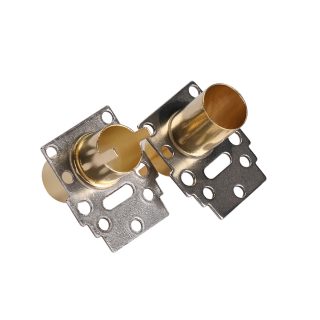
Our premium shielding tube, crafted from high-quality C3602 brass and SUS304 stainless steel, delivers exceptional durability, corrosion resistance, and electromagnetic shielding performance.
Reviews
There are no reviews yet.