
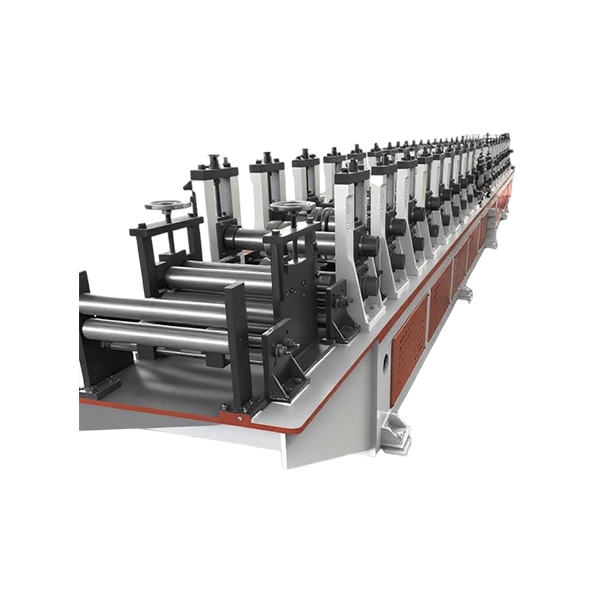
Heavy-Duty Shelf Roll Forming Machine for Automated Storage Rack Production
High-speed automatic warehouse shelf & rack roll forming machine with CNC punching & servo tracking flying shear. CE certified. Get a free quote today!
As demand for warehouse storage systems, supermarket shelving, and industrial racking continues to grow, manufacturers need production equipment that can deliver consistent profile accuracy, structural strength, and high output. A shelf roll forming machine provides an integrated solution for manufacturing metal shelf uprights, support beams, and shelving panels through a continuous forming process.
Designed for processing different types of steel strips, this production line combines automatic material feeding, sheet leveling, CNC punching, progressive roll forming, and precision cutting. Its automated configuration helps reduce manual handling while maintaining consistent dimensions across large production batches.
Designed for Heavy-Duty Shelf Profile Manufacturing
Storage rack components must withstand substantial loads while maintaining dimensional stability. The forming equipment is therefore designed to process steel strips into profiles with specific cross-sectional shapes and structural characteristics.
The line supports the production of heavy-duty rack uprights, step beams, and shelf panels. With a material thickness range of 1.5–3.0 mm and feeding strip widths from 100–320 mm, it accommodates various shelf profile designs used in commercial and industrial storage systems.
The production line can reach speeds of 30–50 m/min, depending on the material and production configuration. A servo tracking flying shear system allows profiles to be cut to the required length while the forming process continues, helping maintain production efficiency without repeatedly stopping the line.
For manufacturers handling different shelving designs, adjustable roller stands or quick-change cassette systems can also be incorporated into the machine configuration, subject to the selected production requirements.
Integrated Production Process and Main Equipment
An automated shelf roll forming line consists of several coordinated units. Each component performs a specific task, helping ensure that the steel strip moves through the production process in a controlled and consistent manner.
1. Hydraulic Uncoiler with Loading Car
The hydraulic uncoiler is available with a 3-ton or 5-ton loading capacity. It feeds steel coils into the production line and provides stable material payoff for continuous processing.
2. Multi-Roll Precision Leveling Unit
Steel coils may retain curvature and internal stress after rolling and storage. The multi-roll leveling system helps flatten the strip before it enters the punching section, providing a more stable starting condition for subsequent forming operations.
3. CNC Servo Punching System
The high-speed CNC servo punching unit creates holes and other required features along the shelf profile. Depending on the product design, punching patterns can include tear-drop, butterfly, and rectangular configurations.
Its multi-station arrangement supports customized hole positioning and pattern requirements for different storage rack structures.
4. Main Cold Roll Forming Section
The main forming machine uses 20 forming stations to gradually shape the steel strip into the required cross-section. Progressive forming helps distribute deformation across multiple stages rather than creating the entire profile in a single operation.
The roller system is manufactured from Cr12MoV alloy steel and undergoes precision machining and vacuum heat treatment. These processes are intended to improve tooling hardness, wear resistance, and service durability during repeated production.
5. Servo Tracking Flying Shear
The hydraulic servo tracking flying shear cuts finished profiles to preset lengths without requiring the production line to stop for every cutting operation. Its synchronized movement supports continuous manufacturing and helps maintain cutting accuracy.
6. Automatic Run-Out Stacker
After cutting, finished shelf components are transferred to the automatic run-out stacking unit. The system collects and organizes the profiles while helping prevent unnecessary surface abrasion during handling.
Technical Specifications of the Shelf Roll Forming Line
The machine can process cold-rolled steel, hot strip, and galvanized steel strip. Its main technical parameters are summarized below.
| Specification | Technical Details |
|---|---|
| Applicable Materials | Cold Rolled Steel, Hot Strip, Galvanized Steel Strip |
| Material Yield Strength | ≤ 350 MPa; higher-yield-strength options available |
| Material Thickness | 1.5–3.0 mm |
| Feeding Strip Width | 100–320 mm |
| Production Speed | 30–50 m/min |
| Forming Stations | 20 stations |
| Roller Material | Cr12MoV alloy steel, hardened and vacuum heat-treated |
| Shearing System | Hydraulic servo tracking flying shear |
| Control System | Siemens / Delta PLC with touchscreen interface |
| Total Motor Power | Approximately 55 kW |
The actual machine configuration can be determined according to the required shelf profile, raw material characteristics, and production specifications. For projects involving higher-strength steel or multiple profile designs, these factors should be confirmed during equipment planning.
Applications in Different Storage and Retail Environments
A shelf roll forming production line can serve manufacturers supplying several types of storage and display systems.
Warehouse and Logistics Racking
Large warehouses and logistics facilities require storage structures capable of supporting heavy loads and organizing goods efficiently. The machine can produce rack uprights, cross beams, and shelf panels used in pallet racking and other industrial storage configurations.
Supermarket and Retail Shelving
Retail display systems often require consistent profile dimensions and carefully positioned mounting holes. The CNC punching and roll forming processes support the production of metal shelving frames, brackets, and related structural components.
Industrial Factory Storage
Manufacturing facilities use modular storage racks, equipment shelving, and high-density storage structures to organize materials and components. The forming line can manufacture the metal channels and framing members required for these systems.
Automation, Tooling, and Production Considerations
When selecting roll forming equipment, manufacturers should evaluate more than the maximum production speed. Material thickness, yield strength, profile geometry, punching requirements, and cutting accuracy all influence the final machine configuration.
The integrated workflow combines automatic uncoiling, precision leveling, CNC punching, multi-pass forming, flying shearing, and automatic stacking. Coordinating these processes helps reduce repeated manual handling and supports continuous production.
Tooling quality is another important consideration. The use of Cr12MoV alloy steel rollers, together with precision machining and vacuum heat treatment, is intended to provide resistance to repeated forming contact and help maintain profile consistency over extended operation.
The control system uses a Siemens or Delta PLC with a touchscreen interface, allowing operators to manage production settings and coordinate the different machine sections.
Frequently Asked Questions
Can one production line manufacture different shelf profiles?
Yes. The equipment can be configured with adjustable roller stands or quick-change cassette systems to accommodate different product designs, including shelf upright posts, step beams, and shelf panels. The specific configuration depends on the profile dimensions and forming requirements.
How long does machine manufacturing take?
The stated standard manufacturing lead time is approximately 45–60 days. Before shipment, each machine undergoes full-load testing with actual steel coils to check its operating performance and production precision.
Is overseas installation and operator training available?
Yes. The engineering team provides international on-site installation, machine commissioning, and operator training. Lifetime technical guidance is also available to support customers after installation.
Choosing the Right Shelf Roll Forming Equipment
Selecting suitable roll forming equipment requires a clear understanding of the intended products and production targets. Buyers should define the required profile types, steel specifications, thickness range, punching patterns, and finished product lengths before confirming the machine configuration.
For manufacturers producing warehouse racks, retail shelving, or industrial storage components, an integrated shelf roll forming machine can combine several production stages into one coordinated workflow. With appropriate tooling, automated material handling, CNC punching, and servo-controlled cutting, the line provides a practical manufacturing solution for consistent shelf profile production.
Related products
-
 Contact Us
The ELF features a compact, durable design that is easy to carry and deploy by a single person, making it suitable for long-time missions.
-
 Contact Us
Filtering efficiency:PM2.5,99%; PM0.5,95%
Power environment:220/380V/3P 50HZ(Can be customized)
Work noise:≤65dBA
Filter life:8 - 12 months
Way in: Horizontal
Way out:Top and side -
 Contact Us
The company specializes in producing various kinds of bends, header boxes, welded pipes, membrane walls, separators and finned economizers for boilers, pressure vessels, electric power and other industries.
-
 Contact Us
Type finned tube heat exchanger elements maintain a high capacity for heat transfer, possess superior self-cleaning properties and retain the ability to effect flue gas waste heat recovery in boiler renovations.
-
 Contact Us
The company specializes in producing various kinds of bends, header boxes, welded pipes, membrane walls, separators and finned economizers for boilers, pressure vessels, electric power and other industries.
Reviews
There are no reviews yet.