
Horizontal vs Vertical Cartoning Machine: Which Automated Solution Fits Your Production Line?
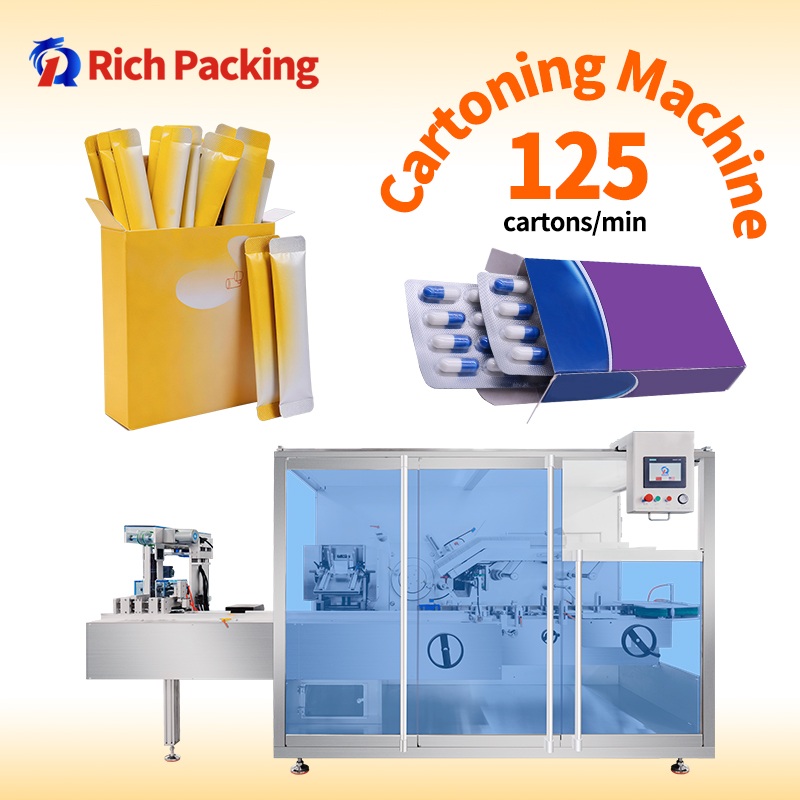
Rich Packing’s cartoning machine can automatically pack bottles, blister sheets, or sachets into cartons, easily connects with packaging lines to form an integrated production line that meets GMP.
When pharmaceutical, nutraceutical, or food manufacturers reach the final stage of packaging—boxing individual bottles, blisters, or pouches into retail-ready cartons—they face a critical equipment decision: horizontal or vertical cartoning machines. Both automated carton packers serve the same fundamental purpose, yet their operational principles, space requirements, and suitability for different production environments vary significantly. Understanding these distinctions helps production managers optimize efficiency, minimize downtime, and ensure GMP compliance in secondary packaging operations.
Understanding the Core Operational Differences
Horizontal cartoning machines operate with cartons moving through the system in a flat, horizontal orientation. Products are typically loaded from the side or end of the carton, which then travels horizontally through folding, gluing, and closing stations. This configuration excels when handling heavier items, multiple product types simultaneously, or materials requiring gentle handling during insertion. The horizontal feed path naturally accommodates bottles, blister packs, tubes, and irregularly shaped items with minimal risk of tipping or shifting during transit.
Vertical cartoning machines, conversely, erect and fill cartons in an upright position. Products drop or are pushed downward into the vertically-oriented carton from above. This top-loading approach proves particularly efficient for lightweight items, uniform products, and high-speed operations where gravity assists product placement. Vertical systems generally occupy less floor space due to their compact footprint, making them attractive for facilities with limited production area.
Space Utilization and Factory Layout Considerations
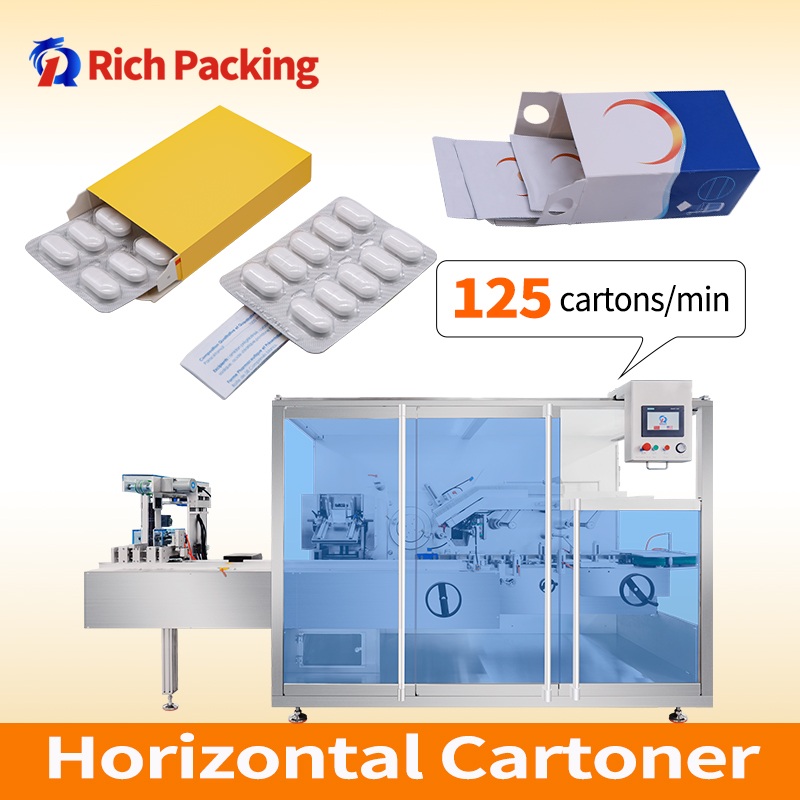
Floor space represents a premium asset in modern manufacturing facilities. Vertical cartoning machines typically require 30-40% less floor space compared to horizontal equivalents with similar output capacity. Their vertical architecture consolidates multiple operations into a smaller footprint, ideal for facilities operating in urban areas or expanding production without facility enlargement.
However, horizontal systems offer superior accessibility for operators and maintenance technicians. The linear layout simplifies troubleshooting, changeovers, and routine cleaning—critical factors in pharmaceutical environments adhering to strict cGMP protocols. Guangdong Rich Packing Machinery Co., Ltd., a leading manufacturer with over 32 years of experience in pharmaceutical packaging solutions, emphasizes that space efficiency must balance with operational accessibility when selecting cartoning equipment.
Product Compatibility and Versatility Analysis
Product characteristics heavily influence cartoning machine selection. Horizontal cartoning machines demonstrate exceptional versatility across diverse product formats. They efficiently handle:
• Bottled products with counting lines: Pharmaceutical tablets, capsules, or gummies already counted and bottled require stable horizontal transport to prevent tipping before carton insertion
• Blister packs of varying sizes: Alu-Alu or Alu-PVC blisters feed smoothly through horizontal systems regardless of dimensional variations
• Irregularly shaped items: Tubes, sachets, or medical devices with non-uniform geometry benefit from side-loading mechanisms
Vertical systems excel with:
• Lightweight, uniform products: Standardized boxes, pouches, or small bottles that benefit from gravity-assisted loading
• High-volume, single-SKU runs: When production focuses on one product type for extended periods, vertical machines maximize throughput efficiency
• Space-constrained operations: Facilities prioritizing floor space conservation over product diversity
Speed, Efficiency, and Production Volume Considerations
Both machine types achieve impressive speeds, yet operational contexts determine optimal performance. Vertical cartoning machines often edge ahead in pure speed metrics for lightweight, uniform products, with some models exceeding 200 cartons per minute. The gravity-assisted loading reduces mechanical complexity and cycle time.
Horizontal cartoning machines, while potentially slightly slower in maximum speed specifications, deliver superior consistency across product changeovers. Rich Packing’s modular design philosophy, demonstrated across their pharmaceutical machinery portfolio, enables rapid format changes—a capability that translates to higher effective output when manufacturers produce multiple SKUs. The company’s engineering team of 48 R&D specialists has developed cartoning solutions that reduce changeover time significantly, addressing the industry pain point of excessive downtime during product transitions.
For facilities running integrated production lines—from capsule filling or tablet pressing through counting, bottling, and final cartoning—horizontal systems often integrate more seamlessly. Guangdong Rich Packing Machinery Co., Ltd. specializes in complete production line solutions where cartoning machines synchronize with upstream equipment like their DSL/RQ Series Electronic Counting Machines (achieving 99.9% counting accuracy) to maintain consistent throughput without bottlenecks.
Maintenance, Reliability, and GMP Compliance
Pharmaceutical and nutraceutical manufacturers operate under stringent regulatory frameworks requiring equipment that supports thorough cleaning, validation, and documentation. Horizontal cartoning machines generally provide easier access to internal components for cleaning and maintenance—essential for preventing cross-contamination when handling different products or formulations.
Vertical systems, with their more compact design, may present accessibility challenges during deep cleaning procedures mandated by GMP protocols. However, modern vertical carton packers increasingly incorporate tool-free access panels and wash-down designs to address these concerns.
Rich Packing, certified under SGS, CE, ISO, and cGMP standards, engineers both horizontal and vertical cartoning solutions with pharmaceutical compliance as a foundational design principle. Their equipment features stainless steel construction, minimal product contact points, and documentation-ready control systems that facilitate validation processes required by regulatory authorities globally.
Cost Considerations: Initial Investment and Operational Economics
Initial capital investment for vertical cartoning machines typically runs 15-25% lower than comparable horizontal systems due to simpler mechanical architecture and reduced material requirements. For startups or smaller manufacturers prioritizing budget efficiency, vertical systems offer an accessible entry point into automated secondary packaging.
However, total cost of ownership extends beyond purchase price. Horizontal cartoning machines often deliver superior long-term value in multi-product environments due to:
• Reduced changeover labor: Faster format changes minimize production interruptions and labor costs
• Lower product damage rates: Gentler handling reduces waste from damaged cartons or products
• Extended operational lifespan: Robust construction withstands diverse product handling demands
Guangdong Rich Packing Machinery Co., Ltd. supports clients with comprehensive service models including three-year warranties, lifetime maintenance, and global on-site installation across their service centers in the United States, UAE, and Malaysia. This service infrastructure ensures maximum equipment uptime regardless of cartoning machine type selected.
Making the Strategic Decision for Your Operation
Selecting between horizontal and vertical cartoning machines requires holistic evaluation of production requirements, facility constraints, and long-term strategic goals. Vertical systems optimize space and initial cost for high-volume, single-product operations, while horizontal machines deliver versatility, accessibility, and integration advantages for diverse pharmaceutical and nutraceutical manufacturers.
Rich Packing, recognized as a Top 2 Strategic Partner on Alibaba International and trusted supplier to Fortune 500 pharmaceutical companies including GSK and UCB, offers expertise in matching cartoning solutions to specific production environments. Their integrated approach—spanning from capsule filling and tablet pressing through counting, bottling, and final cartoning—enables manufacturers to optimize entire production lines rather than individual equipment pieces.
Whether prioritizing floor space efficiency, product versatility, or seamless integration with upstream packaging equipment, understanding the fundamental differences between horizontal and vertical cartoning machines empowers informed decisions that enhance production efficiency, ensure regulatory compliance, and support business growth in competitive pharmaceutical and nutraceutical markets.
Related products
-
 Contact Us
Machining Equipment:CNC lathe/Wire cutting/Surface grinder/Milling maching latheDrilling machining/Horizontal saw.
-
-
 Contact Us
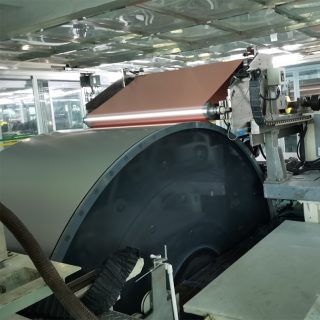
Electrode posited copper foil machine consists of titanium drum, titanium anode tank, titanium anode plate, passivization modules and winding modules.
-
 Contact Us
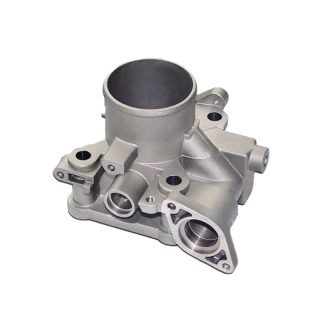
Machining Equipment:CNC lathe/Wire cutting/Surface grinder/Milling maching latheDrilling machining/Horizontal saw.
Reviews
There are no reviews yet.