

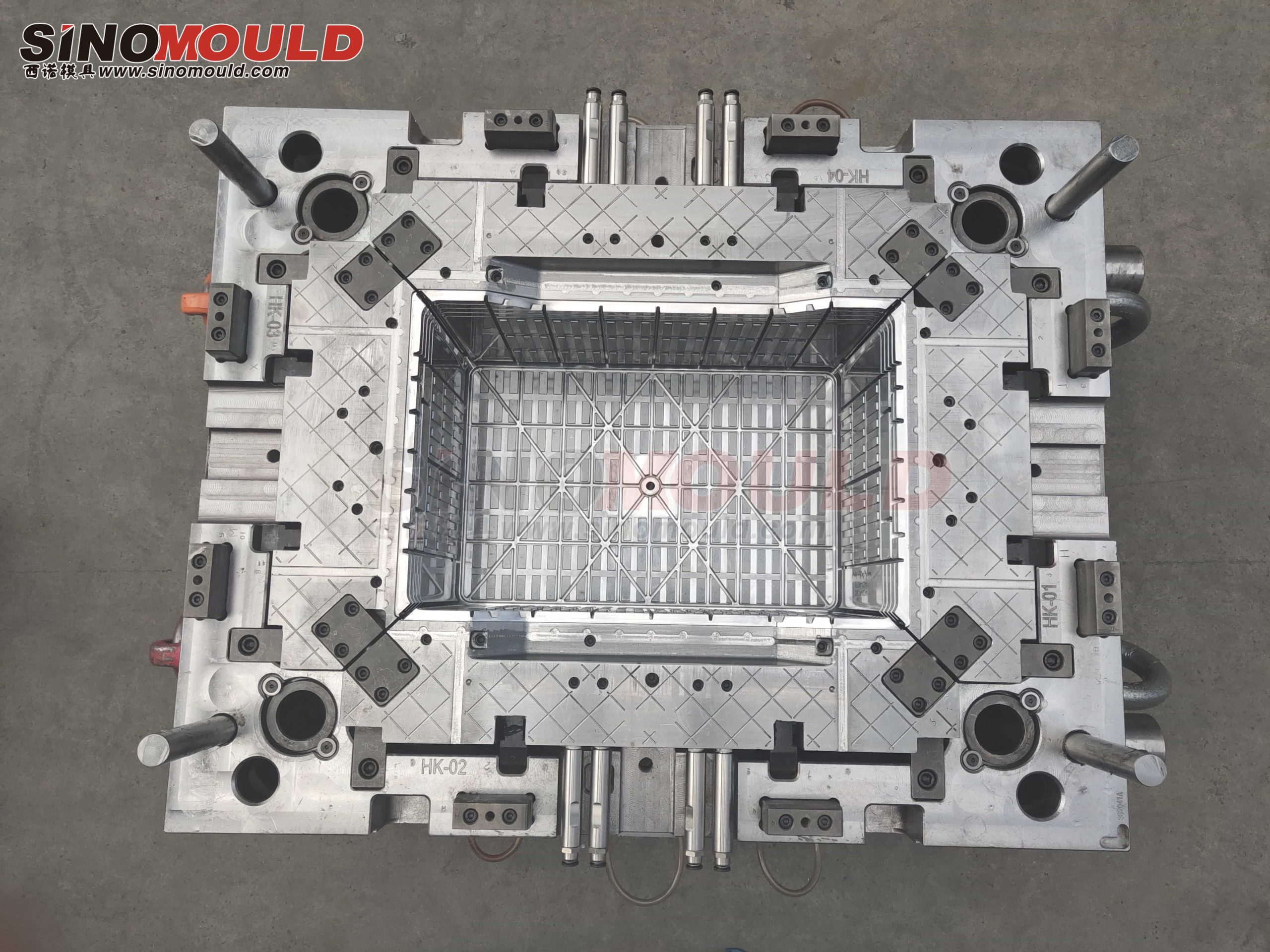
One-Cavity vs Two-Cavity Crate Mold: The Honest Math
Crate mold
Two cavities sound like double the output. On large crates they usually mean double the machine, mold and maintenance — for about 75% more crates.
Quick answer: For a 600×400 mm crate, one cavity needs a 650–850 t machine; two cavities need 1,300–1,450 t and roughly 90% more capital for about 75% more output. Two cavities only pay above roughly 1.2–1.5 million crates a year on a single SKU — below that, the one-cavity crate production line wins on capex, changeover and maintenance.
Clamp force is the first wall
Clamp force scales with projected area. DKM’s rule — area × 250–300 bar × 1.15 — puts one 600×400 mm crate at 690–830 tf, so a 650 t machine is the floor and 850 t the comfortable choice. Double the cavity count and you double the projected area: two cavities need 1,300–1,450 t.
That is a different machine class, not a different option on the same quote.
The mold base is the second wall
A single-cavity 600×400 tool needs roughly a 1,000×800 mm base. A two-cavity tool needs about 1,600×1,000 mm, which no longer fits a 650 t machine with 900×900 mm tie bars. The knock-on costs are easy to miss: a larger robot, stronger take-out gripper, crane-rated mold changes and more floor space for the same building.
Capex and output, side by side
|
Specification |
One cavity |
Two cavities |
|
Machine clamp force |
650–850 t |
1,300–1,450 t |
|
Mold base (600×400) |
~1,000×800 mm |
~1,600×1,000 mm |
|
Cycle time |
25–28 s |
28–32 s |
|
Gross output |
129–144 crates/h |
225–257 crates/h |
|
Relative capex |
1.0× |
1.8–2.0× |
|
Best fit |
Mixed SKUs, new factories |
One SKU at very high volume |
Two cavities add about 75% output for roughly 90% more capital. The unit economics are close; the flexibility is not.
Where two cavities actually win
Two cavities make sense when four conditions hold at once: one product, one color, demand above about 1.2–1.5 million crates a year, and a line that runs near full load for most of the year. Take away any one — a second SKU, seasonal colors, uncertain demand — and the second cavity becomes idle capital. Crate factories usually start with one foldable or pallet box line and add capacity machine by machine. A second single-cavity line can be commissioned when demand proves out, and it can run a different SKU — which a two-cavity tool cannot do.
What moves cost per crate
Resin is about 72% of the cost of a 1.6 kg PP crate (roughly USD 2.75 at USD 1,245/t resin). Cavity count barely touches that; machine utilization does. A single-cavity line running 153 crates an hour at 85% OEE beats a two-cavity line running at 60% OEE — which is the normal outcome when a two-cavity tool waits for demand that has not arrived.
The operating cost nobody quotes
Two cavities also double the work that does not show up in a quotation: color changes purge twice the melt, maintenance covers two cavity sets instead of one, and a single damaged cavity can idle half the tool’s output. On a mixed-SKU crate factory, changeover frequency is the hidden cost of cavitation — and it is the reason most crate producers stay single-cavity well past the point where output alone would justify a second cavity.
About DKM (Sino Group)
DKM Machinery, part of Sino Group, builds fast-speed machines and turnkey crate lines in Taizhou, China: 24+ years in crate production, 1,500+ crate molds and machines, SinoMould tooling and UL 508A-certified machines. The one-cavity crate production line is the standard reference for 400×300–600×400 mm crates.
Related products
-
 Contact Us
The coating includes plasma spraying ceramic wear-resistant coating and supersonic flame spraying carbide cermet coating.
-
 Contact Us
G.A.LED common cathode technology improves brightness with better heat dissipation
-
 Contact Us
Designed for multi-module installation, this battery features high compatibility BSM, ensuring seamless integration with leading inverter brands for reliable and efficient energy storage.
-
 Contact Us
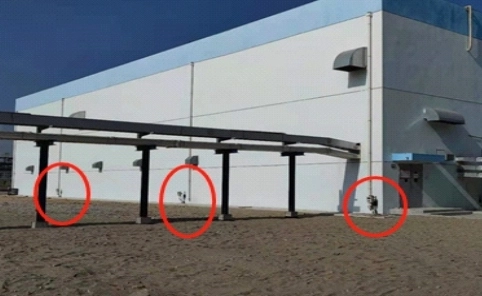
Sunlightweld Earth Resistance Online Detector adopts on-line monitoring technology such as non-contact measurement,not affect the grounding effect and the normal operation of facilities.
-
Reviews
There are no reviews yet.