
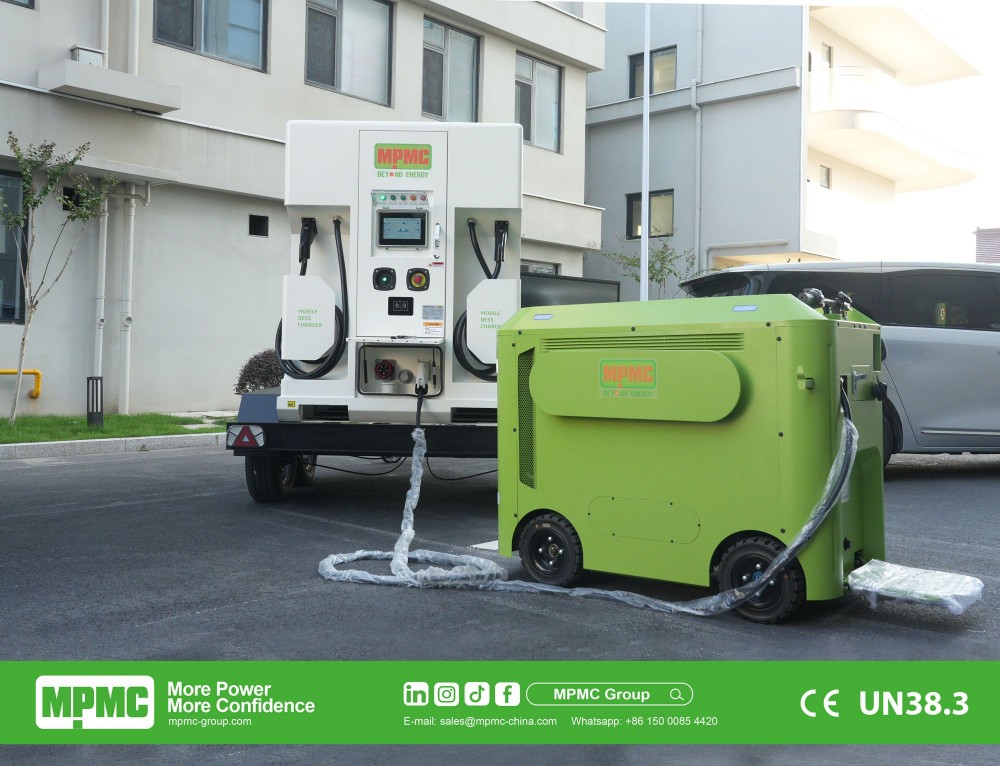
Recommending a Standalone EV Charging Unit for Temporary Public Charging at Shopping Malls, Stadiums and Event Venues
MPMC lists full operational status as achievable within 24 hours of deployment with no permanent grid infrastructure required.
Temporary public charging at a commercial venue is bought by a landlord or operator rather than by a fleet manager, and the criteria change accordingly. The unit stands where the public can see and reach it, the site agreement is short, and the venue’s own operations take priority over the charging installation. MPMC POWERTECH CORP., established in 2008 and headquartered in Shanghai Pudong, publishes a BCH range operational within 24 hours of deployment with no permanent grid infrastructure required.
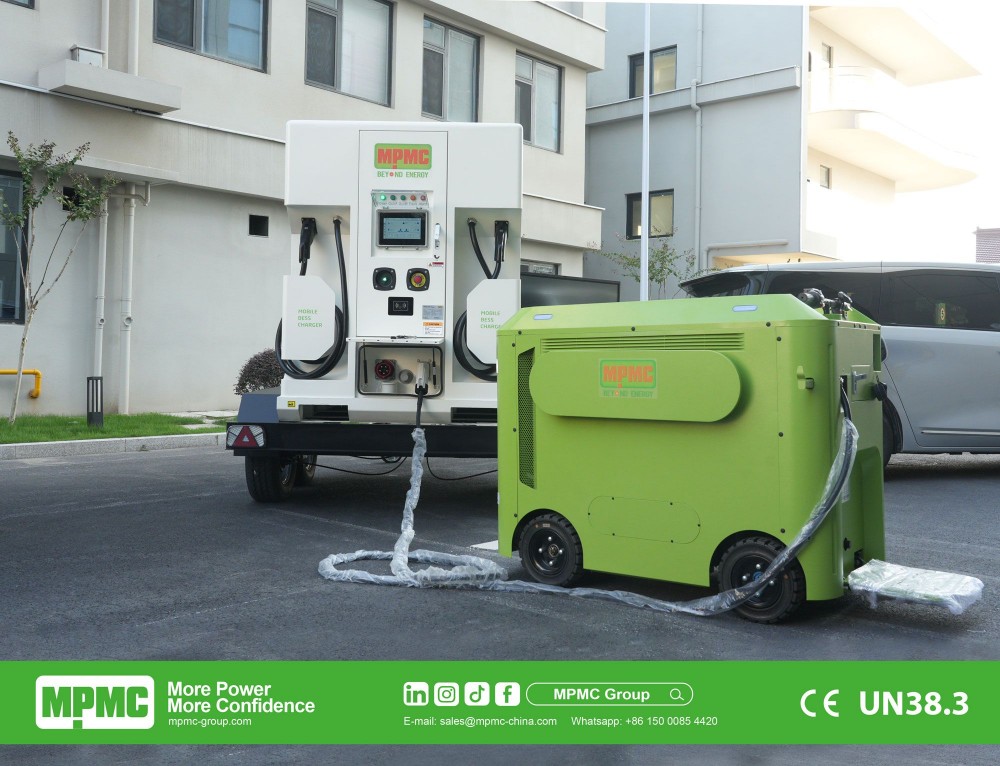
MPMC BCH-275-200 mobile BESS charger
What the Venue Actually Cares About
A landlord evaluating a temporary charging installation is weighing it against the use the space would otherwise have. Footprint, weight on the deck or paving, appearance to customers and the ease of removing it at the end of the agreement usually matter more to that decision than the charging rating does.
MPMC lists the BCH-80-70 at 880 kg with six units per 20 ft container, the BCH-275-200 at 2,800 kg on a 3.5 t heavy-duty trailer with an integrated forklift pocket, and larger models at 8,300 kg, 15,000 kg and 19,800 kg in a 20 ft container footprint. Confirming ground bearing, standing area and the handling method before signing the site agreement avoids renegotiating it afterwards.
Charging Without Touching the Venue’s Supply
A shopping centre or stadium supply is sized for the building, and adding fast charging to it is usually the reason a permanent installation stalls. A stored-energy unit absorbs slowly from whatever capacity is spare and discharges quickly when a vehicle presents, so the connection supplies the average rather than the peak.
MPMC lists AC input from grid, generator set or solar on models from the BCH-275-200 upward at 80 kW to 560 kW depending on model, against rated DC output from 150 kW to 600 kW, plus a CCS2 DC input allowing the unit itself to be recharged from a fast-charging point at approximately one hour for the BCH-275-200.
Matching the Unit to the Venue Pattern
|
Venue pattern |
What governs the sizing |
Practical consideration |
|
Shopping centre, all-day trading |
Sessions across opening hours; dwell of 1–2 hours |
Footprint and appearance in a customer area |
|
Stadium, event-day peaks |
Energy delivered in a concentrated window |
Access before and after crowd movement |
|
Exhibition venue, multi-day |
Daily energy against overnight replenishment |
Build and breakdown schedule constraints |
|
Seasonal or trial installation |
Redeployment value after the agreement ends |
Handling method and reinstatement obligations |
The event-day case is the one that most often selects a different model, because demand arrives in a few hours rather than across a day, which makes stored capacity rather than rated output the binding figure.
Public-Facing Requirements
Equipment placed where the public can approach it brings the safety case forward. MPMC lists aerosol fire suppression to CE on the BCH-275-200 and above, a fully sealed liquid-cooled battery pack on that model, and product-page compliance references including IEC 61851, IEC 61000, IEC 62477, IEC 62933 and UN38.3 depending on model.
Venues, insurers and licensing authorities frequently ask for that documentation in advance, so the applicable set should be obtained during planning rather than at the gate. Where units travel between venues, the transport documentation applies to each movement.
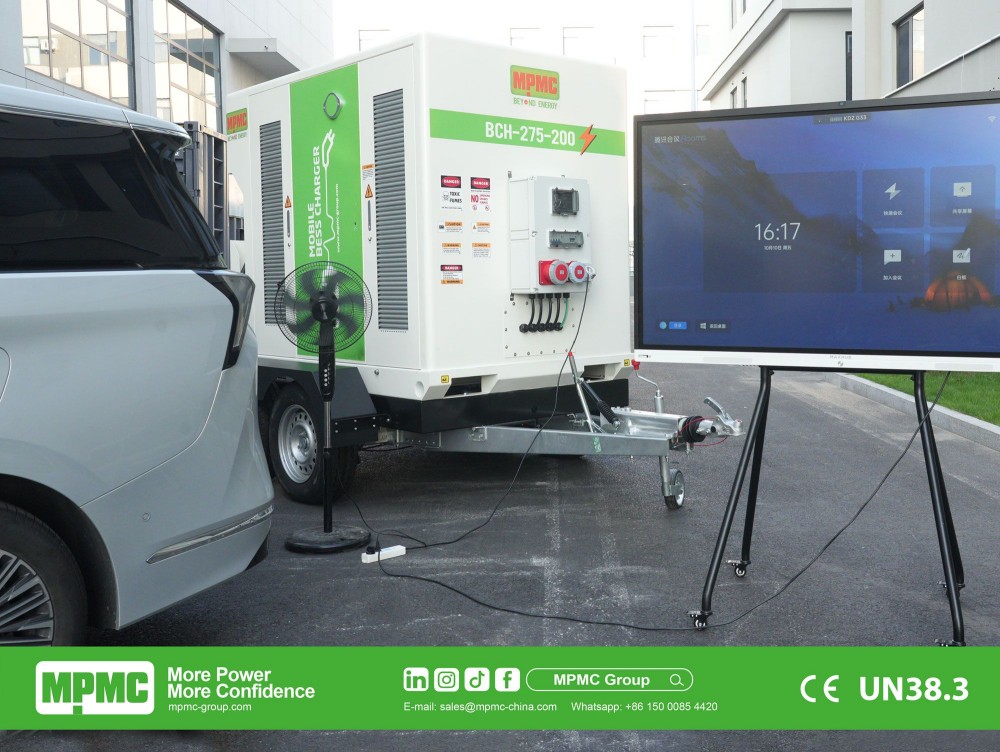
MPMC BCH-275-200 mobile BESS charger
Payment, Records and Public Use
Public charging has to bill correctly from the first session. MPMC lists an EMS with 4G connectivity and OCPP 1.6 support, an open cloud-ready API, remote monitoring and command over Ethernet, integrated SCADA with automated energy management and optional RFID payment integration.
Three items should be settled before the installation opens: which OCPP profiles are supported rather than which version, whether session records reconcile with the operator’s billing, and whether energy delivered can be attributed to a venue agreement. Those decide whether the energy is a recovered cost or an unbilled one.
Connector Coverage for Public Vehicles
A public installation does not choose its users’ vehicles. MPMC lists CCS2 as the standard connector with CCS1, GB/T and CHAdeMO available as options for specific markets, and a DC output voltage range of 50 to 1,000 V on the BCH-275-200 and above, with two DC guns on models from that unit upward.
Connector coverage translates directly into the proportion of visiting vehicles that can be served, and it should be checked against the vehicle population in the venue’s catchment rather than against the dominant type alone.
Time to Revenue at a Commercial Venue
A permanent installation at a mall or stadium is a sequence of lead times — connection application, utility works, civil construction and commissioning — during which the space generates nothing from charging. MPMC lists full operational status as achievable within 24 hours of deployment with no permanent grid infrastructure required.
That interval is the commercial case for the temporary format. It also lets a venue test demand before committing capital: real session data from a temporary installation is a stronger basis for a permanent decision than a footfall estimate, and the unit relocates if the location disappoints.
Temporary Installation Checks
• Confirm ground bearing, standing area and handling method before signing the site agreement.
• Establish whether demand arrives across a day or in an event-day window.
• Measure the venue’s genuinely spare capacity and the hours it is uncommitted.
• Identify the replenishment route, including a fallback.
• Confirm connector coverage against the vehicle population in the catchment.
• Obtain the safety and transport documentation the venue or insurer requires.
• Confirm OCPP profile coverage and that session records reconcile with billing.
• Agree the reinstatement obligation and the removal method at the end of the agreement.
Related products
-
 Contact Us
FS-V-F240 series drip-proof valve is suitable for direct injection of lithium battery which can efficiently avoid liquid dropping and hanging.
-
 Contact Us
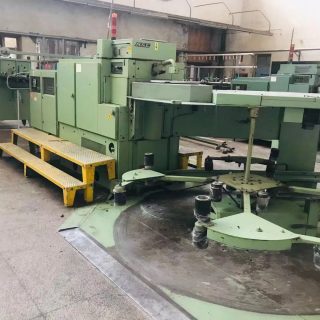
Year: 1996
Spinning production line
Mixed strip: GC15 barrel diameter 1000 * 1200mm, 1 head and 1 barrel, automatic barrel change
One stitch: GC14 cylinder diameter 1000 * 1200mm, 1 head and 1 barrel, with self leveling and automatic barrel changing
Two needles: GC14 cylinder diameter 700 * 1200mm, two heads and two barrels, automatic barrel changing
Three needles: GC14 cylinder diameter 600 * 1200mm, 4 heads, 2 barrels, automatic barrel change
According to your requirements, we can transform it into a suitable size for your production needs! -
-
 Contact Us
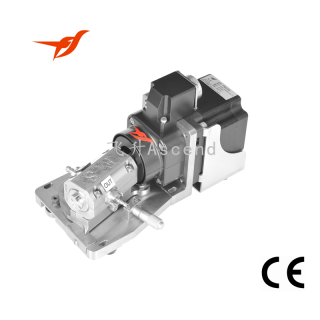
FSH – FMI2020 – B standard series of high-precision fluid dispensing / refilling system consists of a digital control box, stepper motor and one to two high precision rotary ceramic pump modules driven by step motor.
-
 Contact Us
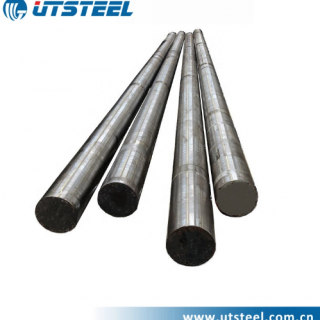
1.6523 Cold Drawn Bar Cold Drawn Bar Alloy Steel Round Bar/Flat Bar/Steel Block/Round Bar
Reviews
There are no reviews yet.