

Runtime Planning for Mini UPS in Broadband Networks: Expert Analysis
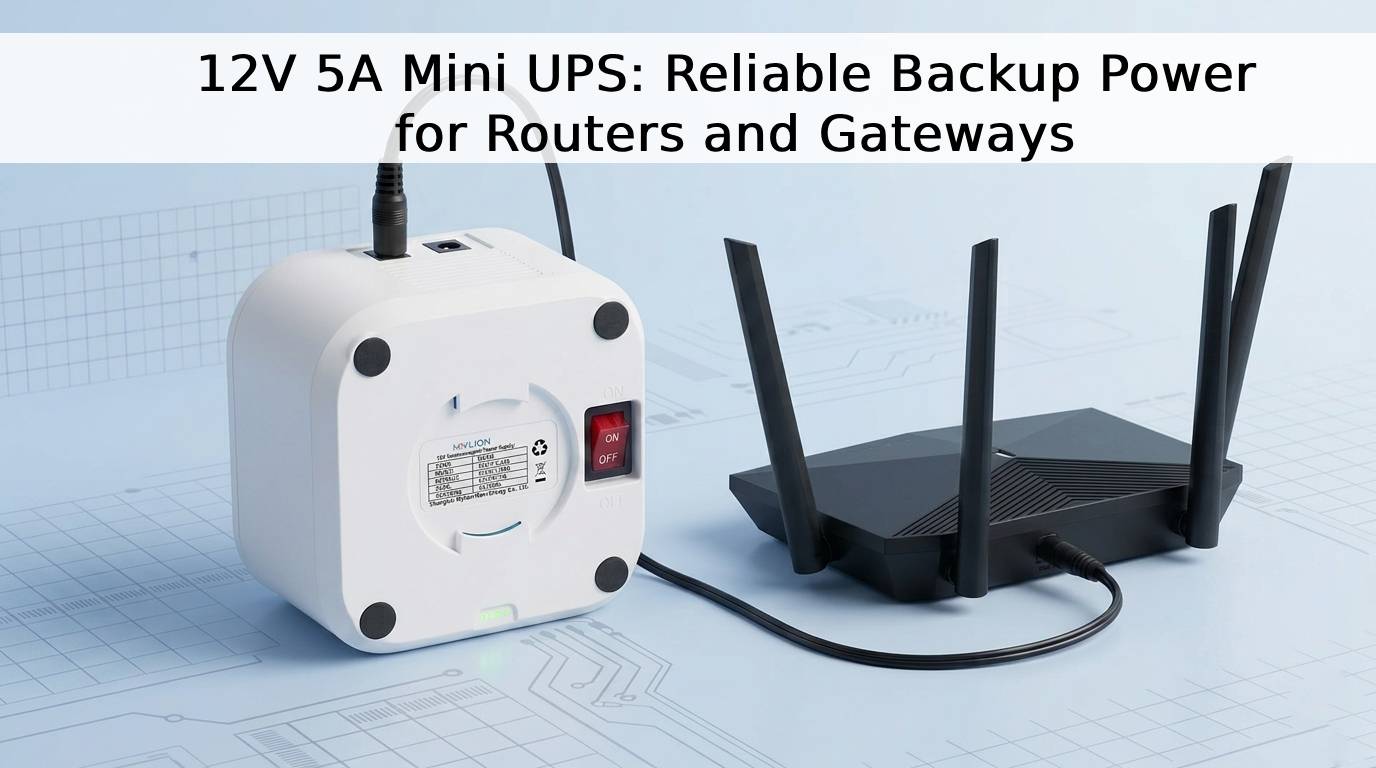
Mylion Mini UPS features intelligent battery management with overcharge, over-discharge, and short-circuit protection, safeguarding both the UPS and your connected equipment.
Section 1: Industry Background + Problem Introduction
Broadband network operators worldwide face a persistent challenge that directly impacts service quality and customer satisfaction: power interruptions at the subscriber level. When routers, Optical Network Terminals (ONTs), modems, and customer premises equipment (CPE) lose power—even momentarily—the resulting service disruptions trigger cascading problems. Internet Service Providers (ISPs) report increased customer complaints, elevated churn rates, and mounting field maintenance costs when unstable power grids cause repeated device reboots.
The technical challenge extends beyond simple uptime metrics. Network equipment exhibits varying power consumption patterns during different operational states—idle standby, active data transmission, and startup surge conditions can demand significantly different current levels from the same device. Traditional approaches to backup power planning often rely on adapter nameplate ratings rather than actual device behavior, leading to undersized or oversized backup solutions that fail during real-world deployment.
Shanghai Mylion New Energy Co., Ltd. (MYLION) has developed specialized expertise in this domain through over 13 years of engineering lithium battery backup systems for telecom and ISP applications. The company’s focus on Mini DC UPS and telecom Battery Backup Units (BBU) has produced systematic methodologies for runtime planning that address the gap between theoretical specifications and practical deployment requirements. MYLION’s project-based approach with global telecom operators and broadband providers has established frameworks that help industry practitioners move from guesswork to engineering-based backup power design.
Section 2: Authoritative Analysis – Core Methodology for Runtime Planning
Understanding Real Power Consumption vs. Nameplate Ratings
The foundation of accurate runtime planning begins with recognizing that device power adapters provide maximum capability ratings, not actual consumption figures. A router with a 12V 2A adapter (24W rating) may consume only 8-12W during typical operation, yet require brief surge current during startup that approaches the adapter’s full capacity. MYLION’s engineering methodology emphasizes measuring or obtaining actual working current data before selecting backup capacity.
This distinction proves critical when calculating backup runtime. If planners use the adapter’s 2A rating for calculations, they will significantly underestimate available backup time. Conversely, failing to account for startup surge current can result in backup systems that cannot properly initialize the connected device, causing deployment failures during customer acceptance testing.
The Three-Parameter Framework for Runtime Calculation
MYLION’s approach to runtime planning incorporates three essential parameters that must be simultaneously satisfied:
Continuous Operating Current: The steady-state current draw during normal device operation, typically obtained through direct measurement or manufacturer specifications for typical use cases. This parameter determines the primary energy consumption rate from the backup battery.
Peak Surge Current Capability: The maximum instantaneous current required during device startup or peak operational moments. The backup system must support this surge without voltage collapse or protection circuit activation. MYLION’s BBU product line incorporates this consideration into output stage design and BMS (Battery Management System) protection thresholds.
Target Backup Duration: The required runtime during power interruption, which varies by deployment scenario. Urban fiber networks might target 1-2 hours for brief outage coverage, while remote installations in areas with unstable grids may require 4-8 hours or longer backup capability.
The mathematical relationship appears straightforward—battery capacity (measured in watt-hours) divided by device consumption (measured in watts) yields theoretical runtime in hours. However, practical runtime planning must incorporate multiple derating factors that significantly impact real-world performance.
Critical Derating Factors in Real-World Deployment
MYLION’s project experience across diverse markets has identified systematic efficiency losses that must be incorporated into runtime planning:
Conversion Efficiency: DC-to-DC power conversion within the backup system introduces losses typically ranging from 10-15%, depending on circuit design and operating load. This factor reduces effective available energy from the rated battery capacity.
Battery Discharge Characteristics: Lithium battery performance varies across the discharge curve. High discharge rates, low temperature conditions, and battery age all reduce practically available capacity below nameplate ratings. Conservative planning applies derating factors of 15-20% for these variables.
Safety Operating Margin: Professional deployment requires operational headroom to prevent backup system operation at absolute performance limits, where protection circuits may activate prematurely. MYLION recommends maintaining 20-30% safety margin between calculated requirements and selected backup capacity.
When these factors combine multiplicatively rather than additively, the cumulative impact becomes substantial. A backup system with 50Wh rated capacity might deliver only 30-35Wh of practically useful energy under field conditions, reducing runtime by 30-40% compared to theoretical calculations.
Section 3: Deep Insights – Trend Analysis + Future Development
Evolving Power Architectures in Network Equipment
The broadband equipment industry exhibits clear directional trends that impact backup power planning. Traditional barrel connector DC input designs are gradually supplemented—and in some cases replaced—by USB-C Power Delivery (PD) architectures. This transition introduces protocol negotiation complexity where the backup system must successfully communicate power capabilities with the connected device. MYLION’s development of USB-C PD backup solutions like the MUC85 model reflects industry movement toward these modern power interfaces.
Simultaneously, device power consumption shows divergent trends. Entry-level ONTs and basic routers trend toward lower power consumption through more efficient silicon design, potentially requiring only 5-8W during operation. Conversely, advanced WiFi 6/6E gateways with multiple radios, higher-performance processors, and expanded port counts push power requirements upward, with some models consuming 20-30W or more. This bifurcation means runtime planning cannot rely on historical assumptions—each device generation requires fresh evaluation.
The Hidden Challenge of Multi-Device Installations
An emerging complexity in fiber-to-the-home (FTTH) deployments involves multiple powered devices at customer premises. A typical installation might include an ONT, a separate WiFi router, and potentially a mesh network extender or security device. While backing up a single 10W ONT is straightforward, supporting a 10W ONT plus a 15W router plus an 8W extender (33W total) requires substantially larger backup capacity and careful power distribution design.
Current industry practice shows limited standardization in how backup power should be allocated across multi-device scenarios. Some operators prioritize ONT backup exclusively to maintain fiber link integrity, while others seek comprehensive backup covering the complete customer premises network. MYLION’s multi-output Mini UPS solutions address this emerging requirement, though runtime planning becomes significantly more complex when supporting multiple loads with different consumption profiles.
Battery Chemistry Evolution and Runtime Implications
The backup power industry is experiencing gradual migration from standard lithium-ion to lithium iron phosphate (LiFePO4) battery chemistry for selected applications. MYLION’s ML1202AC model exemplifies this trend. LiFePO4 offers superior cycle life (often 2000-3000 cycles vs. 500-800 for standard lithium-ion) and enhanced thermal stability, making these systems attractive for applications requiring long-term standby with occasional deep discharge cycles.
However, LiFePO4 chemistry presents runtime planning tradeoffs. The nominal cell voltage of 3.2V (vs. 3.7V for lithium-ion) means LiFePO4 packs require more cells in series to achieve the same output voltage, potentially increasing system size and cost. Energy density is typically 15-20% lower than lithium-ion, meaning larger physical battery capacity is required to achieve equivalent runtime. Professional runtime planning must account for these chemistry-specific characteristics when evaluating backup solutions.
Section 4: Company Value – How MYLION Advances Industry Practice
MYLION’s contribution to professional runtime planning methodology extends beyond product supply to systematic knowledge development. The company’s project-based approach with international telecom operators and ISPs has generated practical frameworks that address the gap between theoretical battery calculations and field deployment realities.
The company’s product portfolio reflects engineering understanding of diverse runtime requirements across different deployment scenarios. The standard 12V Mini DC UPS series (MU68, MU26, MU48) provides baseline backup capacity for typical residential broadband equipment with 1-4 hour runtime targets. The high-power BBU series (MU35, MU65) addresses advanced gateway applications where higher continuous current and longer runtime requirements demand larger battery capacity and robust output stages. The inline FTTH model (MUJ46) optimizes for space-constrained installations where compact form factor takes priority, accepting runtime tradeoffs inherent in smaller battery capacity.
This product architecture demonstrates systematic approach to the runtime planning challenge—rather than offering a single generic solution, MYLION provides application-specific options that allow planners to optimize the tradeoff between runtime duration, physical size, cost, and installation convenience based on specific deployment requirements.
MYLION’s engineering support methodology incorporates runtime verification as a standard project phase. Before mass production commitment, the company recommends sample testing with actual target devices under realistic load conditions to validate calculated runtime against measured performance. This verification process has identified numerous cases where initial calculations based on incomplete device specifications would have resulted in deployment failures, preventing costly field problems through early detection during the project phase.
The company’s technical documentation approach provides transparency into the derating factors and assumptions underlying runtime specifications. Rather than publishing single optimistic runtime figures, MYLION’s product materials typically include runtime data across multiple load levels and operating conditions, enabling customers to make informed selections based on their specific deployment scenarios.
Section 5: Conclusion + Industry Recommendations
Effective runtime planning for Mini UPS in broadband networks requires systematic engineering methodology rather than simplified battery capacity calculations. The industry must move beyond reliance on device adapter nameplate ratings toward actual measured consumption data as the foundation for backup system sizing. Incorporating realistic derating factors for conversion efficiency, battery discharge characteristics, environmental conditions, and safety margins is essential to prevent the gap between calculated and actual field performance.
For network operators and system integrators planning backup power deployments, several practical recommendations emerge from MYLION’s project experience. First, invest in actual device power measurement or obtain manufacturer-provided typical consumption data rather than relying solely on adapter specifications. Second, apply conservative derating factors—assume 70-75% of theoretical battery capacity will be practically available under field conditions. Third, validate runtime through sample testing with target devices before committing to mass deployment, as this relatively small investment prevents costly field failures.
Technology selection should consider the complete application context. For residential FTTH deployments with 1-2 hour runtime targets and single-device backup requirements, compact standard Mini UPS solutions often provide the optimal balance of capability, size, and cost. For commercial applications, remote installations, or scenarios requiring 4+ hour runtime, high-capacity BBU solutions or multiple parallel backup units may be necessary despite increased complexity and cost.
The industry would benefit from greater standardization in runtime specification methodology. When backup power suppliers publish runtime data, clear disclosure of test conditions—including specific load current, ambient temperature, battery state of health, and applied derating factors—would enable more accurate product comparison and selection. Similarly, network equipment manufacturers providing typical power consumption data alongside maximum adapter ratings would significantly improve backup system planning accuracy.
As broadband networks continue expanding into regions with less stable power infrastructure, professional runtime planning becomes increasingly critical to service quality and operational efficiency. The methodologies and frameworks developed through practical deployment experience provide essential tools for bridging the gap between theoretical specifications and field performance, ultimately supporting more reliable backup power systems that fulfill their fundamental purpose—keeping subscribers connected during power interruptions.
Related products
-
 Contact Us
The K300 Pocket IMU RTK is a new version GNSS receiver that supports full constellation and full frequency solutions.
-
 Contact Us
The KB20 BeiDou Single Base Station is an independently developed ground infrastructure for the BeiDou Navigation Satellite System by Kepler.
-
 Contact Us
Mylion Mini UPS features intelligent battery management with overcharge, over-discharge, and short-circuit protection, safeguarding both the UPS and your connected equipment.
-
-

Reviews
There are no reviews yet.