
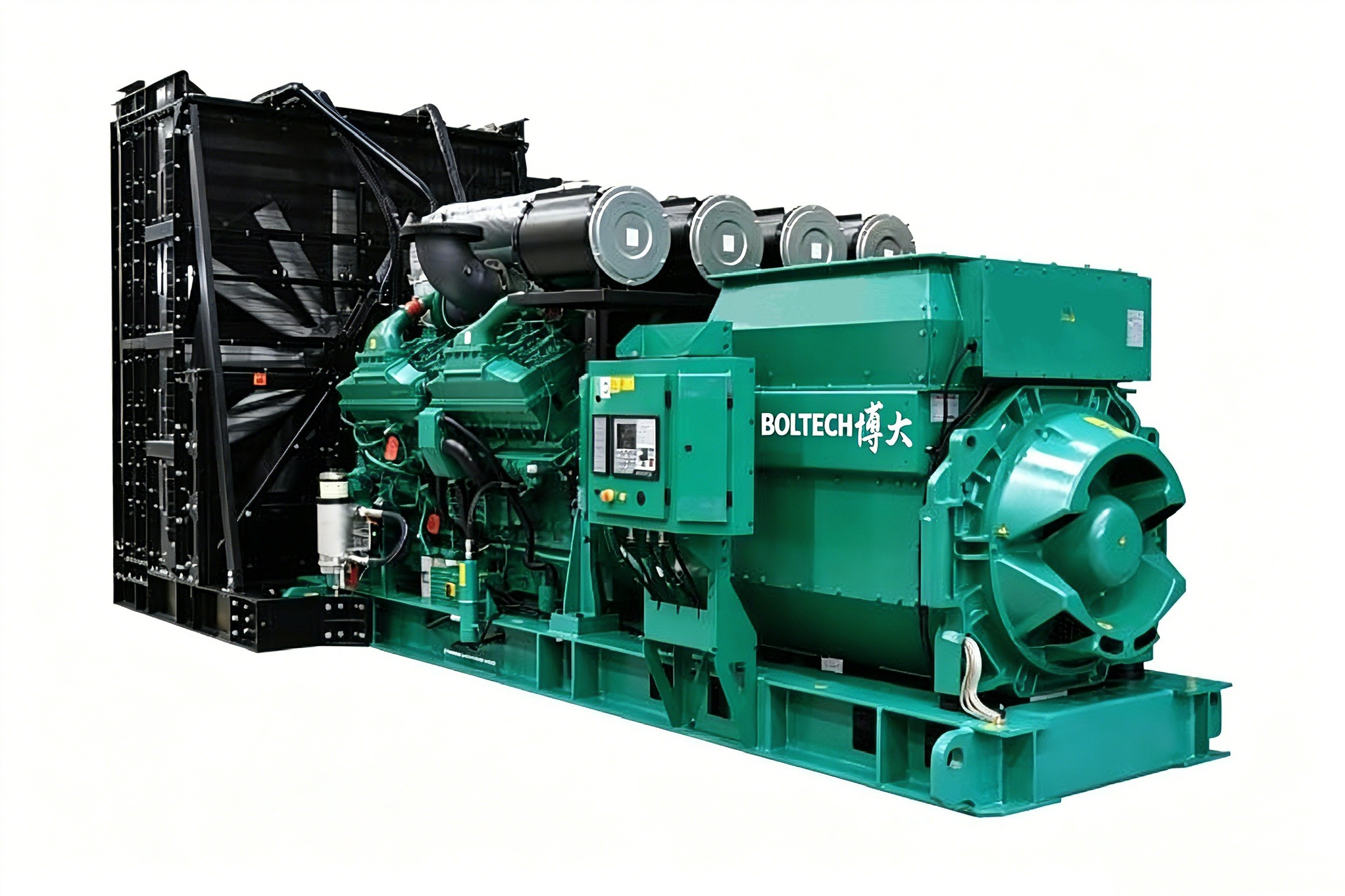
Diesel Generator Set Low Voltage BDC1600GF 2000KVA 400V/50Hz Prime Power/ Cummins QSK60-G11
Applicable Standards:
ISO 8528:Reciproacting Internal Combustion Engine Driven Alternating Current Generator Set
IEC 60034-1:Rotating Electrical Machines-Fundamental Technical Requirements
YD/T 502:Diesel Generator Set for Communication Use
GB/T 20136-2006:General Test Methods for Internal Combustion Engine Power Stations
Product Advantages:
Advanced electronic-controlled engine capable of compensating for load, temperature, fuel calorific value, and atmospheric pressure. This reduces engine wear, improves fuel efficiency and output power, and lowers NOx and particulate emissions.
Optimized combustion chamber geometry that enhances compression ratio and air–fuel ratio, ensuring thorough mixing of fuel and air. This significantly reduces pollutant emissions, while the lower piston temperature and in-cylinder pressure help reduce mechanical stress.
Integrated ductile-iron pistons that provide superior thermal expansion and contraction characteristics, improving cylinder durability by up to 15%.
New-generation high-pressure fuel injection system delivering improved atomization and more uniform distribution within the combustion chamber. This enhances cold-start performance, transient load response, and overall engine performance.
Performance Guarantee:
The transient response of the generator set is fully tested in accordance with ISO 8528-5 standards.
Proven product design, quality, and performance integrity.
All engine systems are verified through prototype validation and factory testing.
For industrial facilities, large commercial developments, infrastructure projects, and other power-intensive applications, selecting a diesel generator set requires careful consideration of output capacity, engine performance, electrical stability, cooling requirements, and installation conditions.
The BDC1600GF diesel generator set is designed for high-capacity power generation, with a prime power rating of 1600 kW and a standby power rating of 1760 kW. Powered by the Cummins QSK60-G11 engine, this generator set combines a large-displacement diesel engine with a three-phase alternator and configurable control and output systems.
This article reviews the BDC1600GF's main technical specifications, fuel consumption data, alternator options, installation requirements, and configuration choices to help project engineers and procurement teams assess its suitability for their applications.
1. BDC1600GF Generator Set: Key Specifications
The BDC1600GF is rated for 2000 kVA at a power factor of 0.8 lagging. Its electrical output is specified for 400 V, 50 Hz, three-phase, four-wire operation at a rated speed of 1500 rpm.
| Parameter | Specification |
|---|---|
| Model | BDC1600GF |
| Prime Power | 1600 kW |
| Standby Power | 1760 kW |
| Generator Set Capacity | 2000 kVA |
| Rated Voltage | 400 V |
| Rated Frequency | 50 Hz |
| Rated Speed | 1500 rpm |
| Rated Current | 2886.4 A |
| Power Factor | 0.8 lagging |
| Electrical Connection | Three-phase, four-wire |
| Overall Dimensions | 5720 × 2570 × 2790 mm |
| Dry Weight | 14,650 kg |
| Wet Weight | 15,400 kg |
| Recommended Foundation Dimensions | 6200 × 3000 mm |
These specifications provide an initial reference for electrical design, equipment layout, transportation planning, and foundation preparation.
The 2000 kVA rating corresponds to 1600 kW at a power factor of 0.8. However, the actual usable output depends on the specified operating rating, site conditions, connected load, and applicable operating limitations. The prime and standby ratings should not be treated as interchangeable.
2. Cummins QSK60-G11 Engine Performance
The BDC1600GF uses the Cummins QSK60-G11 diesel engine. Its large displacement and 16-cylinder configuration are intended for high-output power generation applications.
Key engine specifications include:
-
Engine model: QSK60-G11
-
Manufacturer: Cummins
-
Configuration: Four-stroke, turbocharged
-
Cylinder arrangement: 16-cylinder, V-type
-
Displacement: 60.2 L
-
Cylinder bore: 159 mm
-
Stroke: 190 mm
-
Compression ratio: 14.5:1
-
Rated speed: 1500 rpm
-
Prime/standby engine power: 1727/1955 kW
-
Governing method: MCRS, as specified in the supplied data
-
Cooling method: Closed-loop water cooling
-
Dry engine weight: 7920 kg
The engine's rated power differs from the generator set's electrical output because the complete system includes mechanical and electrical conversion losses, as well as rating and configuration considerations.
For project evaluation, buyers should confirm the engine's rating definition, the selected alternator's output capability, and the complete generator set's applicable prime and standby ratings.
Starting system
The starting system is specified with a 9 kW starting power rating and a DC 24 V starting voltage. The listed standard configuration includes maintenance-free lead-acid batteries with cables, a battery charger, and a negative battery switch.
Depending on the installation environment and startup requirements, optional equipment may include a coolant jacket heater, an engine oil heater, or a pre-lubrication system. These options should be evaluated against the local climate, expected standby duration, and startup procedures.
3. Fuel Consumption at Different Load Levels
Fuel consumption is an important factor when estimating operating costs, planning fuel storage, and determining refueling intervals.
The supplied engine data lists the following fuel consumption figures:
| Engine Output | Fuel Consumption | Specific Fuel Consumption |
|---|---|---|
| 100% | 394 L/h | 194 g/kWh |
| 75% | 295 L/h | 194 g/kWh |
| 50% | 201 L/h | 198 g/kWh |
| 25% | 114 L/h | 224 g/kWh |
The figures indicate that hourly fuel consumption decreases as the engine operates at lower output. However, the specific fuel consumption in grams per kilowatt-hour increases at the lower load points shown.
This distinction matters when comparing operating scenarios. A generator running at a lower load generally consumes less fuel per hour, but it may use more fuel per unit of energy produced.
For preliminary planning, hourly fuel consumption can be multiplied by the expected operating hours to estimate fuel requirements. Actual consumption will depend on the real load profile, ambient conditions, engine condition, fuel characteristics, and system configuration.
The supplied data identifies fuel flow rate in L/min as unavailable. Buyers requiring detailed fuel-system design should request the relevant technical documentation and confirm the applicable fuel-consumption test conditions.
4. Alternator Options and Electrical Compatibility
The BDC1600GF can be configured with alternators from several manufacturers. The supplied options are intended for 50 Hz, AC 400 V operation at a power factor of 0.8.
| Alternator Model | Rated Power | Standby Power | Mechanical Efficiency | Protection Class | Weight |
|---|---|---|---|---|---|
| Marathon 743RSLA054 | 1600 kW | 1630 kW | 95.4% | IP21 | 3588 kg |
| Stamford S7L1D-G4 | 1664 kW | 1736 kW | 96% | IP23 | 3637 kg |
| Leroy-Somer LSA52.3S6 | 1600 kW | 1680 kW | 95.9% | IP23 | 3748 kg |
All three listed alternators have H/H insulation and temperature-rise classifications in the supplied data. Their general configuration includes air cooling, an automatic voltage regulator (AVR), brushless field excitation, a single bearing, and a star-wired connection.
When comparing alternators, procurement teams should look beyond rated power and efficiency. Other considerations include:
-
Compatibility with the engine and generator set ratings
-
Motor-starting requirements and transient load response
-
Protection coordination and fault-current requirements
-
Ambient temperature and ventilation conditions
-
Environmental protection requirements
-
Maintenance access and available technical support
The protection classes also differ between the listed models. The selected alternator should therefore match the installation environment rather than being chosen solely on the basis of its rated power.
Final selection should be confirmed against the manufacturer's approved configuration and the electrical requirements of the project.
5. Voltage and Frequency Regulation
Electrical stability is essential when a generator supplies equipment that is sensitive to voltage or frequency fluctuations. The BDC1600GF specification includes several frequency- and voltage-regulation indicators.
| Performance Parameter | Specified Value |
|---|---|
| Frequency Drop | ≤ 3% |
| Steady-State Frequency Band | ≤ 0.5% |
| Relative Frequency Droop Range | ≥ 3.5% |
| Relative Frequency Rise Range | ≥ 2.5% |
| Transient Frequency Deviation | ≤ +10% / ≤ -7% |
| Frequency Recovery Time | ≤ 3 s |
| Relative Frequency Tolerance Band | 2% |
| Steady-State Voltage Deviation | ≤ ±1% |
| Voltage Unbalance | 1% |
| Transient Voltage Deviation | ≤ +20% / ≤ -15% |
| Voltage Recovery Time | ≤ 4 s |
| Voltage Modulation | 0.3% |
| Relative Voltage Adjustment Range | ≤ ±5% |
| Voltage Adjustment Rate | 0.2–1%/s |
| Telephone Harmonic Factor (THF) | < 2% |
| Telephone Influence Factor (TIF) | < 50 |
These figures provide a basis for reviewing the generator set's stated regulation performance. The exact test definitions, load conditions, and acceptance criteria should be confirmed in the detailed technical documentation before they are used for contractual or compliance purposes.
For applications involving large motors, transformers, variable-frequency drives, or sensitive electronic equipment, engineers should also evaluate load-step behavior, harmonic performance, and the generator's ability to handle the expected starting and operating loads.
6. Intake, Cooling, and Exhaust Requirements
A high-output diesel generator requires adequate airflow and carefully designed intake, cooling, and exhaust systems. Insufficient ventilation or excessive exhaust back pressure can affect operating performance and equipment reliability.
The supplied BDC1600GF specifications include the following values:
| Parameter | Specification |
|---|---|
| Generator Set Air Inlet Flow | 2700 m³/min |
| Generator Set Air Outlet Flow | 2831.64 m³/min |
| Engine Intake Air Flow | 131.64 m³/min |
| Maximum Clean-Filter Intake Restriction | 3.7 kPa |
| Exhaust Gas Flow | 310.68 m³/min |
| Exhaust Gas Temperature | 454°C |
| Maximum Allowable Exhaust Back Pressure | 7 kPa |
| Minimum Exhaust Pipe Diameter | 2 × φ203 mm |
| Engine Coolant Capacity | 159 L |
| Total Lubrication System Capacity | 280.1 L |
| Maximum Allowable Engine Oil Temperature | 121°C |
The generator set's ventilation requirements should be incorporated into the equipment-room design. Engineers need to consider air inlet and outlet placement, heat rejection, airflow resistance, ventilation openings, and the effect of nearby structures.
The exhaust system should be designed according to the engine manufacturer's requirements, taking into account pipe length, bends, silencer selection, back pressure, thermal expansion, and safe exhaust discharge.
The listed generator set airflow and engine intake airflow refer to different system requirements and should not be used interchangeably. Final ventilation and exhaust calculations should follow the approved technical drawings and manufacturer documentation.
7. Standard Equipment and Optional Configurations
The BDC1600GF is offered with a range of standard equipment and optional components, allowing the configuration to be adapted to the installation and control requirements.
Standard configuration
The supplied configuration list marks the following items as standard:
-
Engine and alternator
-
Control system
-
Integrated generator set output
-
Maintenance-free lead-acid battery with cables
-
Battery charger
-
Negative battery switch
-
40°C radiator
-
Industrial silencer
-
Steel chassis
-
Rubber anti-vibration mounts
Optional engine and fuel-system equipment
Available options listed in the supplied documentation include:
-
Oil-water separator
-
Coolant jacket heater
-
Engine oil heater
-
Heavy-duty air filter
-
Intake shut-off valve
-
Air start system
-
Pre-lubrication system
-
Chassis fuel tank or day tank
-
Automatic fuel refill system
-
Underground fuel tank
-
PLC-based main fuel control cabinet
Fuel storage and replenishment arrangements should be selected according to the expected operating duration, site regulations, refueling access, and project safety requirements.
Optional alternator equipment
Alternator-related options include an anti-condensation heater, stator temperature sensor, bearing temperature sensor, permanent magnet generator (PMG), digital voltage regulator, and differential protection.
The suitability of each option depends on environmental conditions, monitoring requirements, protection design, and the selected alternator model.
Control and output options
The listed control and output choices include:
-
Standalone control
-
Automatic transfer switch (ATS) control
-
Parallel control
-
Grid-parallel control
-
Centralized remote monitoring
-
Integrated generator set output
-
Parallel total output cabinet
-
Independent output cabinet
-
ATS cabinet
-
Distribution cabinet
Standalone control may suit projects that require an independent power source. ATS control can support automatic transfer between utility and generator supplies when the complete system is properly designed. Parallel and grid-parallel configurations require additional consideration of synchronization, load sharing, protection, and applicable electrical regulations.
These options should be confirmed as part of the final bill of materials rather than assumed to be included in every generator set.
8. Dimensions, Weight, and Foundation Planning
The BDC1600GF has listed overall dimensions of 5720 × 2570 × 2790 mm. Its dry weight is 14,650 kg, while the wet weight is 15,400 kg.
The recommended foundation dimensions are 6200 × 3000 mm. These dimensions provide an initial reference for equipment layout, but they do not replace a site-specific structural assessment.
Before installation, the project team should verify:
-
The final approved generator set dimensions and weight.
-
Foundation load capacity and mounting details.
-
Equipment access for transportation, lifting, installation, and maintenance.
-
Ventilation and exhaust routing.
-
Fuel-system access and spill-control provisions.
-
Service clearances and vibration-isolation requirements.
The supplied dimension diagram is for reference only. Actual dimensions and weight should be based on the final design drawings.
9. Operating Conditions and Power Derating
The stated operating conditions for the BDC1600GF are:
-
Altitude: Up to 1000 m
-
Ambient temperature: 40°C
-
Relative humidity: Up to 60%
Power derating is required when altitude exceeds 1000 m or ambient temperature exceeds 40°C, according to the supplied notes. If site conditions fall outside the stated operating parameters, the available output may need to be reduced.
The final derating factors should be obtained from the relevant engine and alternator technical documentation. Engineers should also confirm fuel quality, cooling capacity, ventilation, and any additional environmental requirements that may affect performance.
The prime power rating is described as the maximum power available for continuous operation with variable load under standard conditions. The supplied notes also permit a 10% overload for one hour in every 12 hours of operation. This allowance should be verified against the applicable rating standard and the manufacturer's formal operating instructions before being incorporated into a project design.
Conclusion
The BDC1600GF is a high-capacity diesel generator set rated at 1600 kW prime power and 1760 kW standby power. Its Cummins QSK60-G11 engine, 400 V three-phase output, selectable alternators, and configurable control and fuel systems provide a technical basis for evaluating it for demanding power-generation projects.
Successful implementation requires more than matching the nominal power rating to the expected load. Fuel consumption, transient electrical performance, ventilation, exhaust design, foundation capacity, control architecture, and site-specific derating all need to be assessed.
For project engineers and procurement teams, the recommended next step is to confirm the load profile, operating rating, preferred alternator, control requirements, and site conditions with the manufacturer. Reviewing the final technical drawings and configuration documents before purchase can help ensure that the selected generator set meets the project's electrical, mechanical, and installation requirements.
Related products
-
 Contact Us
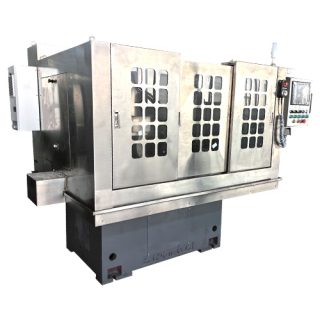
Type: high precision bearing grinder
Abrasives: diamond wheel
Controlling Mode: CNC
Processing Mode: fully automatic
Precision: high precision
Certification: GS, CE, ISO 9001
Customisation: upon request
Place of Origin: Wuxi, China
Machining Accuracy Grade: P4/P5
External Dimensions: 2070mm*1320mm*1880mm
MOQ: 1 set
DM: 3 months
Packaging: three-ply board -
 Contact Us
Our Printing Machine is a high-quality printing device that is designed to meet the printing needs of various industries. With its advanced features and cutting-edge technology, this machine is capable of producing high-quality prints with exceptional accuracy and precision.Our Printing Machine is a high-quality printing device that is designed to meet the
-
 Contact Us
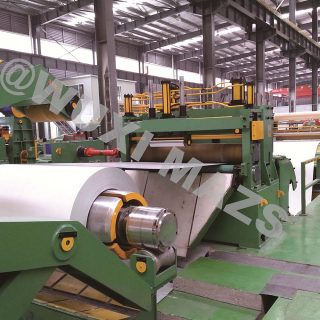
MA-(2~8MM)×1800MM Steel Coil Slitting Line is mainly composed by the following components : uncoiler, guiding device
-
 Contact Us
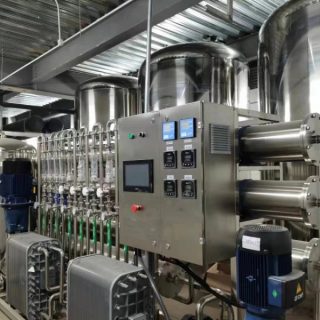
The reverse osmosis equipment passes the raw water through fine filters, granular activated carbon filters, compressed activated carbon filters, etc., and then pressurizes it through a pump, using a p
-
 Contact Us
The water-cooled cabinet condenser uses a water-cooled condenser, and the evaporator directly cools the air.
Reviews
There are no reviews yet.